


Headline: USD/CAD Rebounds as Oil Slumps; Focus Shifts to 1.4013 and Hourly MAs
Key Takeaways
The US dollar is clawing back ground against the Canadian dollar after a steady slide, with USD/CAD reclaiming key technical levels as North American trading picks up. The move comes as weaker oil prices weigh on the loonie, helping lift the pair back into the middle of its recent trading range.
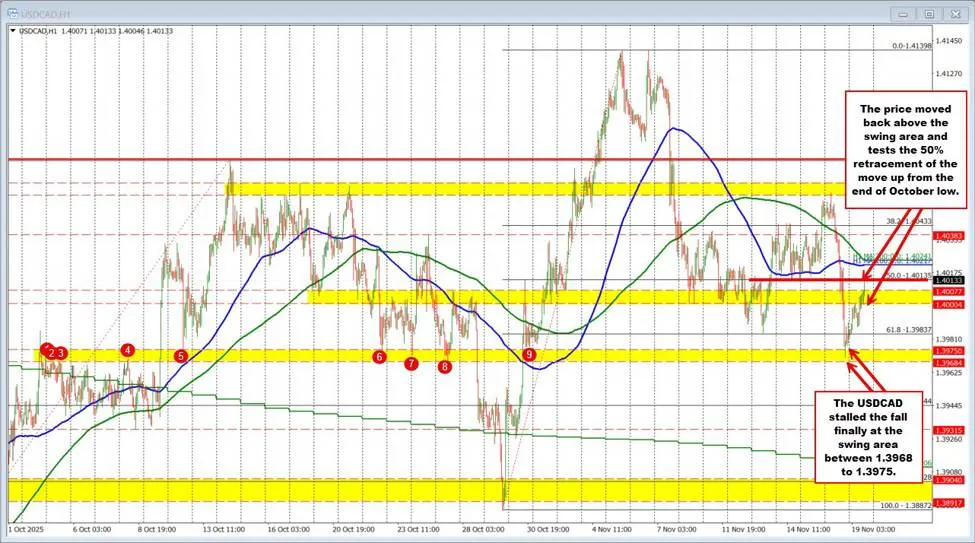
After breaking a series of supports, USD/CAD found buyers at a familiar early-October pivot, stabilizing in the 1.3968–1.3975 support zone. A recovery above the 61.8% Fibonacci retracement at 1.39837 set the stage for a push through the 1.4000–1.4007 swing area. The next resistance markers are the 50% midpoint of the post-October range at 1.40135, followed by the near-aligned 100- and 200-hour moving averages at 1.4022–1.4024. Initial sellers may defend those MAs on first test, but a decisive break could trigger upside momentum. Failure to hold above 1.40135 would put 1.4000 back in play and risk a renewed battle around that level.
On the fundamental side, softer crude prices are undermining the Canadian dollar. Reports of a secret U.S.–Russia plan to end the war in Ukraine pressured oil, sending WTI down $1.65 (-2.72%) to $59.02 and briefly testing $58.12, the weakest level since late October. With USD/CAD back in the heart of its range, traders will look to the 100/200-hour moving averages for direction clues as short-term bias toggles between consolidation and a potential bullish extension.
Key Points – USD/CAD bounced from the 1.3968–1.3975 support zone after a multi-session decline. – Reclaim of the 61.8% Fibonacci level at 1.39837 preceded a break above 1.4000–1.4007. – Next resistance: 1.40135 (50% midpoint), then 1.4022–1.4024 (100/200-hour MAs). – A clean move above the hourly MAs could accelerate gains; failure puts 1.4000 back at risk. – CAD softness tied to weaker oil; WTI fell $1.65 (-2.72%) to $59.02, briefly testing $58.12.
Context
Current positioning around Market Analysis remains sensitive to primary-source updates, policy interpretation, and execution risk across major venues.
What To Watch
Key confirmation signals include sustained spot demand, funding stability, and whether price can hold reclaimed levels after headline-driven volatility.
If momentum weakens, traders will likely prioritize downside liquidity zones and risk-control positioning before adding new directional exposure.
Related: More from Market Analysis | Kalshi Founder Details Iran Leadership Transition Plan in Crypto Market | STRC Yield Surges to 11.50% with New Strategy in Crypto Market