


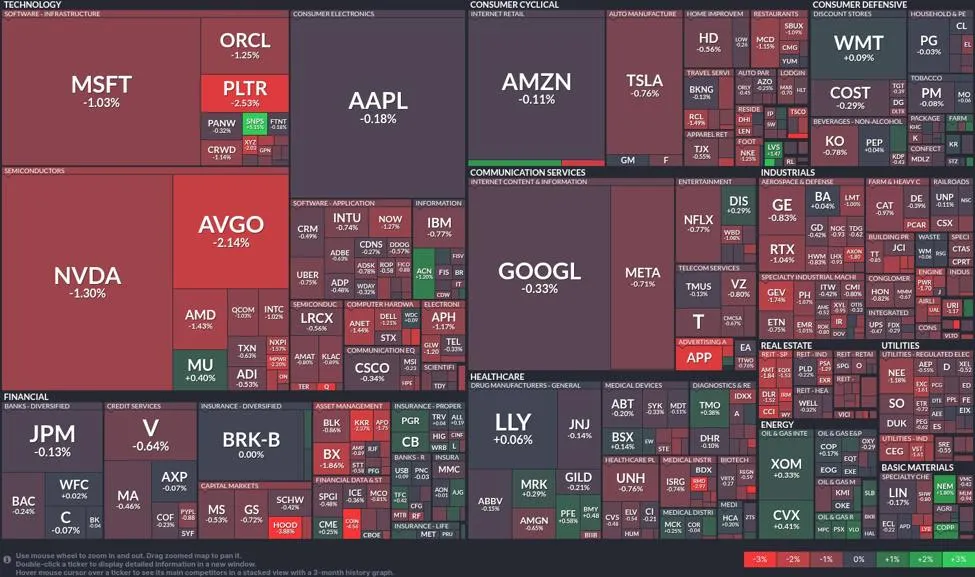

Tech stumbles as semiconductors slip; healthcare steadies Wall Street into December US equities opened December with a defensive tone as technology underperformed and healthcare provided ballast, sharpening focus on rates, the dollar, and year-end positioning for traders.

Sector rotation puts pressure on growth
A tech-led pullback dominated Monday’s market map, with weakness concentrated in software infrastructure and chips. Microsoft fell 1.03% and Palantir dropped 2.53%, underscoring caution around software and AI-adjacent demand. In semiconductors, Nvidia slipped 1.30% and Advanced Micro Devices lost 1.43%, weighing on the broader growth complex.
Defensives outperformed. In healthcare, Eli Lilly edged up 0.06% while Merck rose 0.29%, illustrating a rotation toward earnings resilience and lower beta as traders reassessed risk early in the month.
Key points
- Technology lagged as software and AI-linked names retreated; MSFT -1.03%, PLTR -2.53%.
- Semiconductors added to the drag; NVDA -1.30%, AMD -1.43%.
- Healthcare showed defensive strength; LLY +0.06%, MRK +0.29%.
- Risk tone was cautious, with traders eyeing rates, the US dollar, and liquidity into year-end.
- Rotation favored quality and margins over long-duration growth exposure.
Semiconductors: leadership under scrutiny
Chipmakers remained a focal point after a strong year-to-date run. The latest pullback suggests investors are recalibrating expectations for data-center and AI spending into 2026, as well as gross margin trajectories. With multiple expansion stretched across leading names, any hints of capex discipline from hyperscalers or softer pricing can amplify volatility.
Healthcare acts as a defensive ballast
Pharma and large-cap biotech outperformed on the day, supported by robust balance sheets, diversified pipelines, and comparatively low earnings variability. As growth multiples compress, the sector’s defensive characteristics and cash flow visibility offer a buffer to portfolio risk, especially into thinner December liquidity.
FX and rates lens
A tech-led selloff typically nudges investors toward havens, often supporting the US dollar when Treasury yields hold firm. While the day’s moves were sector-driven, FX desks remain sensitive to shifts in rate-cut expectations, term premium dynamics, and cross-asset volatility. If caution persists, dollar demand can edge higher versus pro-cyclical peers, while lower yields would tend to favor yen and Swiss franc on risk-off days.
What traders are watching
- Incoming US data and central bank commentary that could sway rate expectations and equities’ duration trade.
- NASDAQ-S&P leadership breadth and whether chips regain momentum or extend consolidation.
- Liquidity conditions and year-end rebalancing that can magnify intraday swings.
FAQ
Why are US tech stocks under pressure today?
Investors rotated out of long-duration growth as software infrastructure and chip names slipped. Elevated expectations around AI and cloud demand leave the group more sensitive to valuation resets and macro swings in yields and the dollar.
What’s driving the semiconductor weakness?
Profit-taking after a strong year, coupled with questions about the pace of data-center spending and margins, weighed on leading chipmakers. As positioning remains crowded, small disappointments can trigger outsized moves.
Which sectors are showing resilience?
Healthcare—particularly large-cap pharma—outperformed, benefiting from steadier earnings profiles, strong cash flows, and lower sensitivity to rate volatility.
How could this sector rotation impact the US dollar?
A cautious equity tone can lend support to the dollar if risk aversion rises and yields remain stable. Conversely, a drop in yields and volatility may moderate dollar strength. FX traders are watching the interplay between rate expectations and cross-asset risk appetite.
What should traders monitor next?
Key US macro releases, central bank remarks, and signs of stabilization in semiconductors. Market breadth, volatility indices, and year-end liquidity will also shape the path for risk assets. For more market coverage, follow BPayNews.
Related: More from DeFi & Stablecoins | Stablecoin Payments Focus Shifts to User Networks | ETH Bounces Back: Why TradFi Favors ETH Rise in Stablecoin