


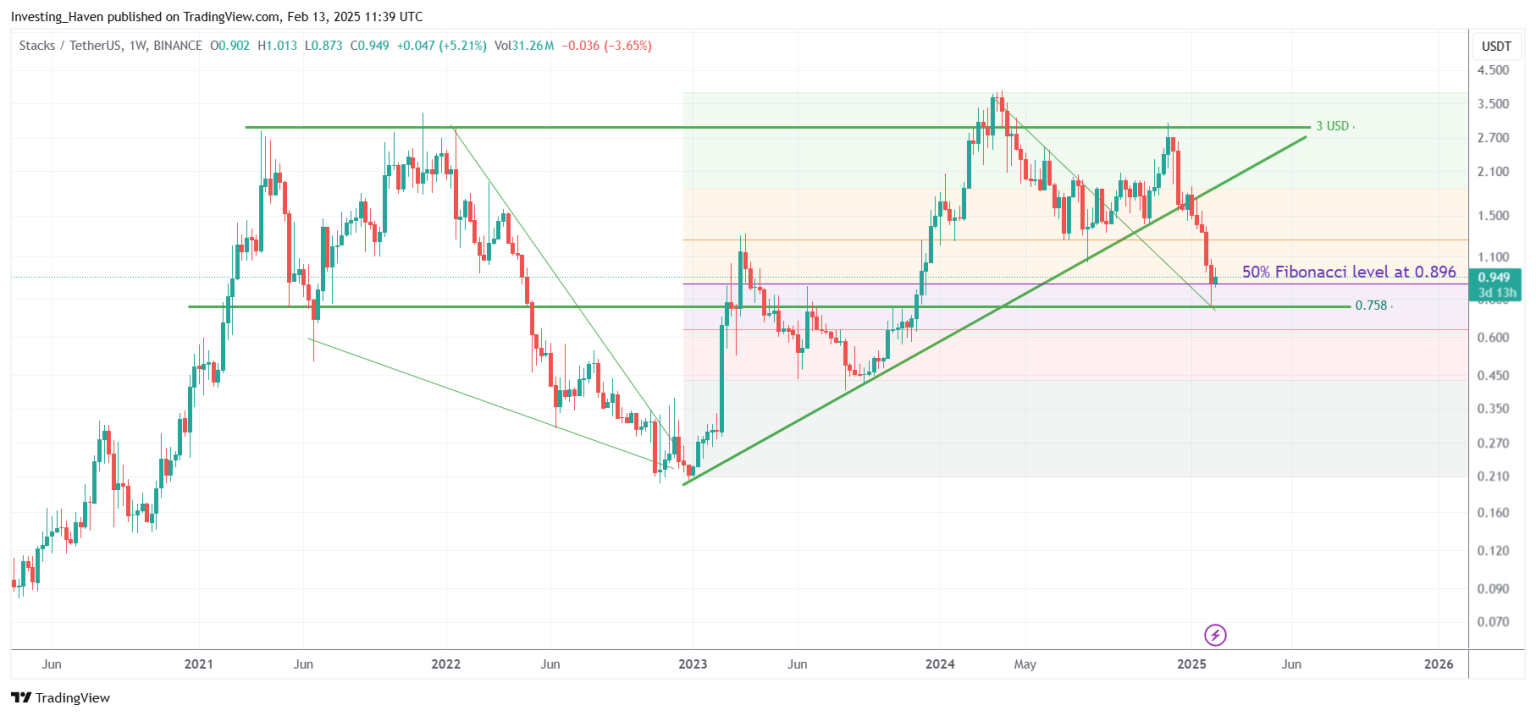

The Stacks price forecast reflects an intriguing future for the STX token, notably as it breaks out from a long-held downward channel. Recently, STX enjoyed a remarkable 12% surge, climbing close to $0.38, largely driven by Bitcoin‘s bullish momentum. Analysts speculate that should Bitcoin maintain its upward trajectory, Stacks could anticipate a retest of the critical $0.56 level. In this context, a thorough STX price analysis reveals potential bullish patterns, even as the market faces overbought conditions. Furthermore, with projections such as the Stacks forecast for 2026 taking shape, investors are keen on understanding how Bitcoin’s impact will influence the performance of STX in the burgeoning cryptocurrency landscape.

As we delve into the future outlook for Stacks, also referred to as STX, the narrative expands beyond just a singular price movement. The technical indicators suggest a reset in momentum, hinting at a pivotal time for altcoins closely tied to Bitcoin fluctuations. Interest in Stacks is surging, with conversations around its price predictions and potential breakout leading to renewed investor optimism. This positive sentiment is buoyed by the overall performance of Bitcoin, which frames Stacks as a strategic asset for future gains in the DeFi space. Ultimately, understanding the intricacies of Stacks’ growth opportunities hinges on comprehensive market analyses and future forecasts.
Stacks Price Forecast: What to Expect in 2026
As we analyze the Stacks price forecast for 2026, it’s crucial to consider the anticipated trends and market factors affecting STX. Given the current bullish momentum driven by Bitcoin’s market performance, analysts predict that Stacks could achieve new highs. With the projected value aiming at $0.56 following recent technical breakouts, there is potential for sustained upward movement if BTC continues its rally. Historically, STX has exhibited strong correlation to Bitcoin’s performance, with significant movements often catalyzing swift price actions in altcoins like Stacks.
Moreover, as DeFi, NFTs, and other scalable applications gain traction on the Bitcoin network, the utility of Stacks is expected to enhance. This increased demand could create a more favorable environment for an upward price trajectory. The market for altcoins is expected to remain volatile, particularly with the influence of Bitcoin’s fluctuations, but the fundamentals supporting STX through various applications suggest that it may reach or even surpass the $0.56 mark in early 2026.
Understanding the Impact of Bitcoin on STX Price Movements
The influence of Bitcoin’s price on STX should not be underestimated. As Bitcoin approaches significant milestones, like the recent highs above $94,000, other altcoins, including Stacks, tend to follow suit. This symbiotic relationship between BTC and STX highlights the importance of monitoring Bitcoin’s market sentiment when predicting STX price movements. When Bitcoin shows bullish signs, as it has recently, traders often flock to altcoins seeking larger percentage gains, creating a ripple effect that can drive prices upwards.
However, it’s essential to consider that the altcoin market, including Stacks, also experiences moments of rational divergences when Bitcoin undergoes corrections. The recent move above $0.37 demonstrates how quickly sentiment can shift in response to Bitcoin’s trends. Given that STX is often viewed as a high-beta play involving Bitcoin dynamics, its price performance can be notably volatile, making it a compelling choice for traders looking to capitalize on crypto market movements.
Stacks Technical Analysis: Breakout Patterns and Implications
The recent technical breakout witnessed in Stacks has significant implications for its price forecast. Analysts emphasize that the breakout from a descending channel not only indicates a possible reversal of the long-standing bearish sentiment but also suggests a transition into a bullish cycle. The channel break above the $0.38 resistance level is critical as it places Stacks above its 50-day simple moving average, indicating potential sustained uptrend momentum.
Furthermore, the Moving Average Convergence Divergence (MACD) indicator, a key tool in technical analysis, is illustrating improving momentum, supporting the bullish outlook. It’s essential for investors to watch for confirmation of this trend over the coming weeks to assess whether buying interest will continue to accumulate or if profit-taking will lead to a consolidation phase. A failure to maintain higher levels could see Stacks revisiting lower support zones around $0.30 and $0.24, reinforcing the importance of market conditions.
Price Analysis of Stacks: Key Levels to Watch
Conducting a price analysis for Stacks reveals several pertinent levels to monitor. The significant focus currently lies on the $0.56 resistance, as it presents a crucial test for bulls looking to maintain momentum heading into 2026. Should STX successfully breach this level, it could signal further buying interest and the potential for price discovery beyond previous highs. Conversely, if the market sentiment weakens, it is vital to recognize that $0.30 could provide immediate support, and below that, $0.24 may be the next area of interest for buyers.
Additionally, price action around these levels will be closely scrutinized as traders seek to capitalize on volatility. The key indicators such as RSI and MACD will play a pivotal role in determining whether bullish momentum can be sustained or if bearish corrections could impede progress. Thus, a solid grasp of these technical factors will guide profitable trading strategies and risk management for STX investors.
Future Price Predictions for Stacks: Insightful Trends
Looking ahead, the future price predictions for Stacks suggest a cautiously optimistic view for the coming year. Given the confluence of bullish signals and the breakout from the descending channel, many traders are looking for an upside move towards $0.56. If Bitcoin continues to perform strongly, the intrinsic link between STX and BTC may drive realizations of positive forecasts. These dynamics are pivotal, especially in a rapidly evolving crypto landscape where investor sentiment can pivot swiftly.
Moreover, the adoption of Stacks technology for decentralized applications is expected to bolster its price stability and growth potential. As more users and developers engage with products built on the Stacks protocol, demand could lead to an appreciation of STX, aligning with analysts’ bullish sentiment. Thus, tracking these developments alongside market trends will be key to understanding and capitalizing on Stacks’ growth trajectory in 2026.
Analyzing the RSI Impact on Stacks Trading
The Relative Strength Index (RSI) plays a crucial role in the analysis of Stacks trading, particularly as the token approaches its overbought levels. The recent rally pushing STX above $0.37 has led RSI metrics to indicate bullish momentum; however, when the RSI surpasses 70, it suggests that the asset may be overbought. This state often precipitates corrections or brief consolidations, prompting traders to reassess their positions. Understanding RSI trends can thus provide valuable insights for traders looking to optimize their entry and exit points.
Conversely, should the RSI experience a pullback while Stacks retains its higher price levels, it could indicate that the rally has more room to run. This market behavior is typical in strong bullish trends, where overbought conditions may persist longer than expected. Therefore, investors should remain vigilant and monitor the RSI alongside market developments to effectively navigate any upcoming volatility in the Stacks price action.
Broader Market Sentiment and its Effect on Stacks
The broader market sentiment is an essential element influencing Stacks’ price movements and overall performance. Recently, the cryptocurrency market has displayed signs of renewed bullish sentiment, bolstered by Bitcoin’s rebound and increasing investor interest across altcoins. This uplift in market sentiment not only drives immediate price actions but also can shape longer-term trends for STX as investors gain confidence in crypto’s resilience and potential.
With platforms such as Stacks poised to leverage DeFi and NFTs within Bitcoin’s ecosystem, positive market sentiment could translate into higher trading volumes and increased demand, further propelling STX towards its price forecasts. Conversely, any negative market shifts, such as regulatory concerns or macroeconomic factors, could result in swift price corrections. Thus, keeping a finger on the pulse of market sentiment will be critical for assessing potential risks and rewards tied to Stacks trading.
The Role of Technical Indicators in Projecting STX Future Prices
Technical indicators are vital tools for projecting STX future prices, helping traders make informed decisions. Moving averages, RSI, and MACD provide insights into market momentum and potential reversals. For instance, the recent technical breakout of STX above its 50-day moving average has triggered signals that may prompt traders to enter bullish positions. These indicators allow for a systematic approach to trading, particularly in a volatile environment where emotional decision-making can lead to losses.
Moreover, the integration of various technical tools criteria can enhance predictions of STX’s price behavior. By employing a combination of indicators, traders can assess the stability of the current bullish trend in light of Bitcoin’s performance. As technical analysis continues to evolve, incorporating a comprehensive approach to understanding STX’s trajectory will be essential for investors looking to navigate through 2026 effectively.
Investment Strategies for Trading Stacks
When it comes to investment strategies for trading Stacks, several key approaches can enhance risk management and profit optimization. Given the volatility associated with crypto assets like STX, employing a diversified strategy may be prudent. For instance, combining short-term trading to capitalize on immediate market movements, especially during bullish scenarios when Bitcoin is driving prices, alongside a long-term holding strategy can create a balanced risk profile.
Additionally, using stop-loss orders below key support levels can help mitigate potential losses, particularly as Stacks faces resistance at pivotal points like $0.56. Furthermore, keeping abreast of market news, technical indicators, and community sentiment can inform traders’ strategies, helping them to adapt to the ever-changing landscape of cryptocurrency markets. This adaptive trading approach will be essential as STX continues to navigate its path through market fluctuations.
Frequently Asked Questions
What is the Stacks price forecast for 2026?
The Stacks price forecast for 2026 anticipates potential growth driven by a breakout of its established channel, with targets around $0.56. Analysts suggest that with Bitcoin’s influence and the overall market optimism, STX could experience substantial upward movement, though caution is advised due to possible pullbacks.
How does Bitcoin impact the STX price prediction?
Bitcoin significantly influences the STX price prediction due to their correlation in price movements. As evidenced by recent trends where STX surged along with BTC’s rally towards $94,000, a boost in Bitcoin often leads to increased momentum and price gains for Stacks, enhancing its bullish outlook.
What are the key technical indicators for Stacks price analysis?
Key technical indicators for Stacks price analysis include the Moving Average Convergence Divergence (MACD) and the Relative Strength Index (RSI). The MACD shows improving momentum, while the RSI indicates overbought conditions, suggesting that while bullish trends are likely, consolidation or retracement may follow.
What potential challenges does the Stacks forecast face due to current market conditions?
The Stacks forecast faces potential challenges due to overbought conditions indicated by the RSI, which suggests a possible pullback or consolidation. Additionally, a significant test of bullish conviction will come at the $0.56 resistance, a level that previously caused a decline during market corrections.
Can Stacks achieve new highs, and what is the target STX price analysis?
Yes, Stacks could achieve new highs, particularly aiming for the $0.56 target in the STX price analysis. This target represents a critical resistance level following a recent breakout, but the movement depends heavily on sustained buying interest amid broader crypto market trends.
What factors should investors consider in their Stacks price forecast?
Investors should consider Bitcoin’s price trends, market sentiment, technical indicators like MACD and RSI, and potential support levels at $0.30 and $0.24 when forming their Stacks price forecast. These factors will provide insights into possible future price movements and risk management.
| Key Points | Details |
|---|---|
| Current Price Movement | Stacks (STX) price has risen by 12%, reaching near $0.38 amid Bitcoin’s recovery. |
| Support and Resistance Levels | The key resistance level to watch is $0.56, while initial support is seen at $0.30. |
| Technical Analysis | STX has broken out from a long-term descending channel, indicating a potential shift in trend. |
| Market Trends | The bullish move is supported by increased buying pressure and strong performance across altcoins. |
| Indicators and Signals | The MACD signals improving momentum, but the RSI indicates the market may be overbought. |
Summary
Stacks price forecast suggests that following a significant channel breakout, the price may retest the $0.56 mark. This forecast is underpinned by a positive trend in the overall cryptocurrency market, especially with Bitcoin’s performance influencing altcoins like Stacks. While there is potential for further gains, investors should be cautious of overbought conditions which might lead to corrections. Nonetheless, the bullish momentum could pave the way for Stacks to reach new price heights.
Related: More from Market Analysis | Figure Shares Drop After Mixed Q4 Results as Crypto Loan Volume Grows | Barclays Looks at Blockchain for Payments, Deposits