

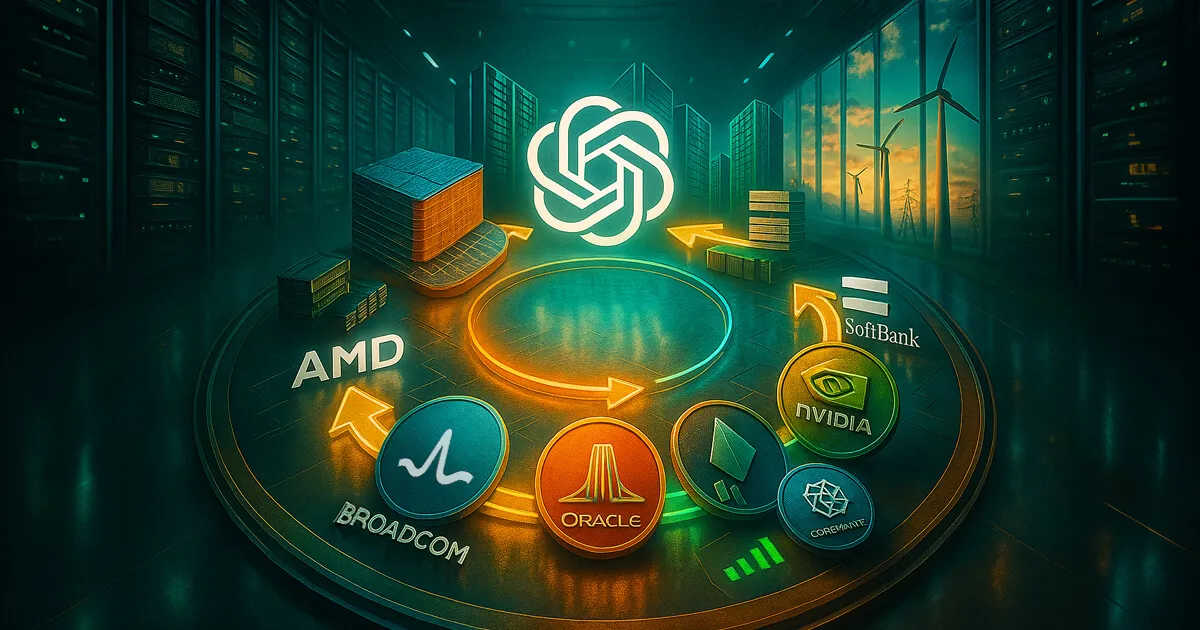

Title: OpenAI’s $300 Billion Bubble Machine: Rewiring the Financial Fabric of Wall Street Through a Feedback Loop Revolution
In an unexpected turn of events that combines technological prowess with financial wizardry, OpenAI, the renowned AI research lab, has taken Wall Street by storm with the launch of what insiders are calling a $300 billion “bubble machine”. This tool, however, isn’t blowing soap bubbles – it’s inflating market sectors through a highly intelligent algorithm designed to create feedback loops that resonate across global financial platforms.
The Genesis of the Bubble Machine
The concept originated from an experimental project looking to integrate advanced predictive analytics in financial environments. OpenAI’s goal was to harness its expertise in machine learning and artificial intelligence to develop a system capable not only of analyzing large volumes of financial data but also influencing market trends predictively.
Named the “Feedback Loop Enhancer,” the technology leverages OpenAI’s cutting-edge machine learning models, including enhancements made to GPT (Generative Pre-trained Transformer) frameworks, to analyze real-time financial data. The system intelligently predicts shifts in market sentiments and dynamically adjusts trading algorithms based on predictive outputs.
Mechanics of the Market Influence
The “bubble machine” operates by creating advantageous trading scenarios that cyclically reinforce positive market trends. It identifies budding trends in specific stocks or sectors and then amplifies these trends by executing large-volume trades that sway market sentiment further. This cascade effect generates momentum in the market, leading to temporary overvaluations—or “bubbles.”
Critically, the system is also designed to predict when these bubbles are likely to burst and recalibrates its positions accordingly, thereby safeguarding investments and capitalizing on both the rise and fall of market valuations. This dual capability to both generate and dissolve financial bubbles presents a novel yet controversial approach to market interaction.
The Impact on Wall Street
The deployment of OpenAI’s technology has redefined how traders and investment firms perceive market dynamics. Traditional strategies that relied heavily on human intuition and historical data are becoming obsolete in the face of AI-driven decisions that can analyze and act on information faster than any human counterpart.
Furthermore, the system’s ability to amplify particular sectors has shown disproportionate effects on the market, leading to increased volatility and concerns about artificial market manipulation. Regulatory bodies are scrutinizing the ethical implications and the potential for systemic risk associated with such AI interventions.
Ethical and Economic Repercussions
The artificial inflation of stock values raises significant ethical questions regarding the fairness and transparency of using AI in trading scenarios. While some argue that all is fair in a laissez-faire economy, others worry about the potential for insider trading-esque scenarios where the machine has information advantages that aren’t available or comprehensible to the average investor.
Economically, the fluctuations induced by such AI systems can lead to misallocations of capital and resources at a macroeconomic level, potentially crowding out funding from sectors that do not receive the AI’s favorable focus but are essential for long-term economic health and stability.
Looking Ahead: The Future of Finance
As we stand on the brink of a new era in financial technology, the integration of AI like OpenAI’s bubble machine on Wall Street is pushing us to rethink not only investment and trading strategies but also the fundamental principles that govern our financial markets.
This powerful technology, if left unchecked, could lead to a rewiring of the financial sector in unpredictable ways. Therefore, it necessitates a balanced approach, incorporating robust regulatory frameworks to prevent abuse and mismanagement. The future will likely see a hybrid model where AI complements human decision-making, providing a symbiotic framework that enhances both market efficiency and stability.
In conclusion, while OpenAI’s $300 billion bubble machine marks a significant milestone in the use of AI in finance, it also beckons a period of introspection and regulation. It’s a clarion call to market participants and regulators alike, urging them to harmonize technological advancements with ethical standards and economic sustainability.