


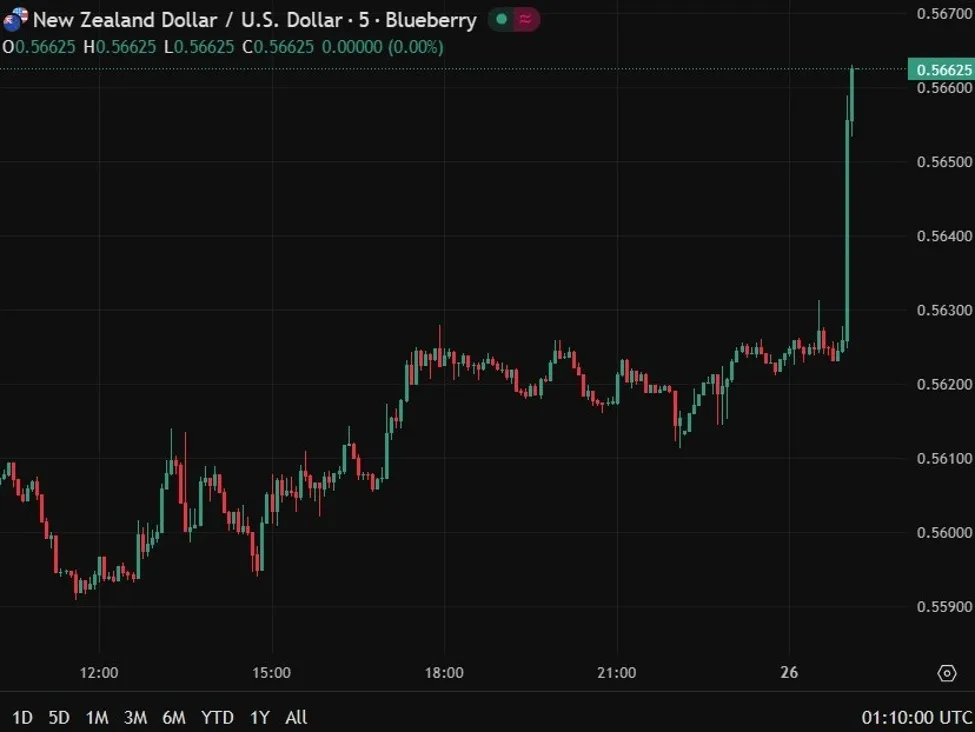

Kiwi and Aussie rally as RBNZ delivers expected cut while hot Australia CPI revives hike talk; yuan fix eyed The New Zealand dollar jumped even after the Reserve Bank of New Zealand trimmed rates by 25 bps, with traders betting the move could mark the end of its easing cycle. The Australian dollar outperformed on a stronger-than-expected inflation print that flipped the policy debate back toward potential hikes. Attention now turns to the People’s Bank of China’s yuan fixing, with a closely watched estimate at 7.0825 per USD.

Asia FX jolted by policy divergence
The RBNZ lowered its cash rate by 25 basis points, a widely anticipated step that came with growing market conviction the bank may now pause. The knee-jerk strength in NZD reflects a “dovish-done” interpretation: cuts were delivered without opening the door to an extended easing sequence. That resonates with a backdrop of sticky services inflation globally and resilient labor markets across pockets of the developed world. In contrast, the Australian dollar’s surge followed an upside inflation surprise that pushed rate-cut speculation aside and revived chatter that the Reserve Bank of Australia may need to tighten further. The shift in Australian rates pricing supported AUD across the board, including AUD/USD and AUD/NZD, as traders recalibrated the policy spread between Wellington and Canberra.
China’s fix in focus as USD/CNY levels steady
Traders are also watching the PBOC’s daily USD/CNY reference rate, with a Reuters estimate suggesting a fix around 7.0825. A firmed fix would underscore the central bank’s preference for currency stability amid uneven growth and ongoing property-sector strains. Stable CNY typically dampens regional FX volatility intraday, though carry dynamics and broader dollar moves remain key drivers.
Global risk tone underpins high-beta FX
U.S. equities advanced, with the Dow up 1.43%, the S&P 500 rising 0.91% and the Nasdaq gaining 0.58%, as softer U.S. data tempered Fed-hike fears and Q3 earnings broadly exceeded expectations. Lower Treasury yields and improved risk appetite are providing a tailwind to higher-beta currencies, adding momentum to AUD and NZD following their domestic catalysts.
Market implications
– The NZD’s post-cut bounce suggests markets see limited additional easing from the RBNZ without a sharper growth or inflation downside surprise. – AUD strength reflects a rapid repricing of RBA risks; any follow-through in wage or services-inflation metrics could cement a higher-for-longer stance. – A stable or stronger CNY fix may moderate Asia FX swings, but dollar direction and global yields remain decisive. – Equity gains and softer U.S. data keep risk appetite constructive, supporting cyclical FX against funding currencies.
Key Points
- RBNZ cut its cash rate by 25 bps, as expected; NZD rallied on bets the easing cycle may be near its end.
- Australian CPI beat drove AUD higher and reignited talk of potential RBA hikes rather than cuts.
- PBOC’s USD/CNY reference rate is in focus, with an estimated fix near 7.0825 watched for FX signals.
- U.S. stocks rose (Dow +1.43%, S&P 500 +0.91%, Nasdaq +0.58%) on dovish data and earnings beats, boosting risk tone.
- FX volatility remains event-driven as policy divergence and data surprises steer intraday flows.
What traders are watching next
– Follow-up RBNZ communications and incoming New Zealand data to confirm whether cuts pause. – Australian wage growth and services inflation for signals on the RBA’s reaction function. – The PBOC’s fixing pattern and liquidity operations for clues on USD/CNY direction. – U.S. yield moves and macro surprises that could reset global dollar sentiment.
FAQ
Why did the New Zealand dollar rise after a rate cut?
The move was fully priced, and markets interpreted the decision as potentially concluding the RBNZ’s easing phase. With limited guidance for further cuts, NZD rallied on a “dovish-done” read and improved global risk sentiment.
Does Australia’s hot CPI mean the RBA will hike?
Not guaranteed, but the upside surprise materially reduces odds of near-term cuts and puts hikes back on the table. Future RBA decisions will hinge on wages, services inflation and growth signals.
How does the PBOC’s USD/CNY fix affect Asia FX?
A stronger or more controlled fix can anchor regional currencies intraday by limiting USD/CNY volatility. However, broader USD trends and global yields still drive medium-term direction.
What does the U.S. equity rally mean for FX?
A risk-on backdrop typically supports high-beta currencies like AUD and NZD against safe-haven or funding currencies. Softer U.S. data that lowers yields can further pressure the dollar.
Which FX pairs are most sensitive now?
NZD/USD and AUD/USD to domestic policy repricing; AUD/NZD to Australia–New Zealand rate differentials; USD/CNY to the PBOC fix and dollar direction. Traders should monitor liquidity and headline risk closely, BPayNews notes.
Related: More from Market Analysis | Polymarket: Traders Bet $500M on US in Crypto Market | Related Box Test