


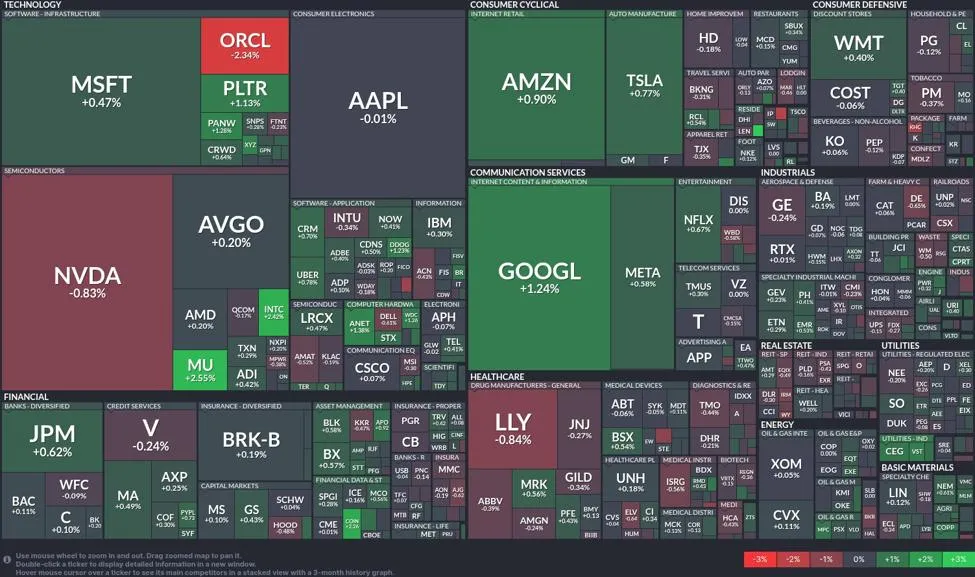

Tech rotation steadies Wall Street as Intel rallies, Google climbs and Nvidia lags U.S. equities closed mixed as traders favored select tech and consumer names while trimming exposure to parts of healthcare and software. A rotation within semiconductors and mega-cap internet helped stabilize risk appetite, even as broader sentiment stayed cautious.

Wall Street at a glance
Investors leaned into cyclical growth where earnings momentum looks durable, lifting chips tied to infrastructure and boosting ad-driven platforms. The tone was constructive but selective, with the market sifting through recent data and guidance for clues on margins and demand into year-end.
Sector moves
Technology: selective risk-on
–
Alphabet (GOOGL)
advanced 1.24%, underpinning the internet content cohort as advertisers and AI-related optionality continue to draw interest. –
Intel (INTC)
jumped 4.42%, leading semiconductors on renewed enthusiasm for compute and foundry-linked exposure, while
Nvidia (NVDA)
eased 0.83%, reflecting rotation away from prior high-fliers. –
Oracle (ORCL)
fell 2.34% as investors locked in gains across some enterprise software names.
Consumer and communication services: steady bid
–
Amazon (AMZN)
rose 0.90%, hinting at resilient e-commerce demand into the holiday period. –
Meta Platforms (META)
added 0.58%, extending the constructive backdrop for digital advertising and engagement.
Financials and healthcare: mixed tone
–
JPMorgan (JPM)
gained 0.62%, highlighting stable large-cap bank sentiment. –
Eli Lilly (LLY)
slipped 0.84% amid a modest fade in recent healthcare momentum.
Cross-asset and FX view
Cross-asset moves suggested a measured risk-on bias rather than a broad rally. Equity leadership skewed toward profitable mega-cap tech and selective semis, a pattern that often tempers currency volatility. The dollar reaction was muted as rates markets offered few fresh signals, keeping major FX pairs range-bound. For traders, the mix of resilient growth equities and contained bond moves points to steady—but fragile—risk appetite ahead of upcoming macro prints.
What it means for traders
Market leadership is narrowing toward cash-generative tech and platforms with visible demand. Semiconductors remain bifurcated: infrastructure and PC/server rebuild narratives drew bids, while premium multiple, momentum-heavy names saw rotation. In FX, a balanced risk tone and stable yields typically cap directional moves; event risk from data and guidance could jar ranges. Liquidity conditions may tighten into period-end, amplifying any surprise.
Market highlights
- Tech leadership rotated: Intel surged 4.42% while Nvidia eased 0.83%.
- Alphabet climbed 1.24%, supporting mega-cap internet; Oracle fell 2.34%.
- Consumer and comms held firm: Amazon +0.90%, Meta +0.58%.
- Financials steady with JPMorgan +0.62%; healthcare softer as Eli Lilly -0.84%.
- Risk tone constructive but selective; FX reaction muted amid stable rates.
FAQ
Why did Intel outperform while Nvidia slipped?
Flows favored semiconductor names tied to compute infrastructure and broader PC/server recovery narratives, benefiting Intel. At the same time, investors rotated out of prior high-momentum chip leaders, leaving Nvidia slightly lower despite a constructive long-term AI backdrop.
How did today’s stock moves affect the U.S. dollar?
The rotation within equities signaled measured risk appetite, but with limited bond market impulse, currency markets stayed range-bound. In such sessions, the dollar typically shows a muted response, with traders awaiting clearer catalysts from data or policy guidance.
Which sectors showed relative strength and weakness?
Strength clustered in selective technology (Alphabet, Intel) and consumer/communication services (Amazon, Meta). Weakness appeared in parts of healthcare (Eli Lilly) and enterprise software (Oracle), reflecting profit-taking and positioning adjustments.
What are the trading implications for FX and equities?
For equities, leadership remains narrow, favoring profitable mega-cap platforms and specific semis. For FX, a steady risk tone and contained yields tend to cap volatility; watch upcoming economic releases and corporate guidance for range breaks.
What should traders monitor next?
Upcoming macro data, any shifts in earnings guidance from large-cap tech, and rate-sensitive signals from the bond market. These will shape risk appetite, equity sector leadership, and whether major FX pairs break out of recent ranges.
This report was prepared by BPayNews for readers seeking actionable context across equities and FX.
Related: More from Market Analysis | Related Box Test | Crypto Worries Over Iranian Oil Supply: Is It Overhyped? in Crypto Market