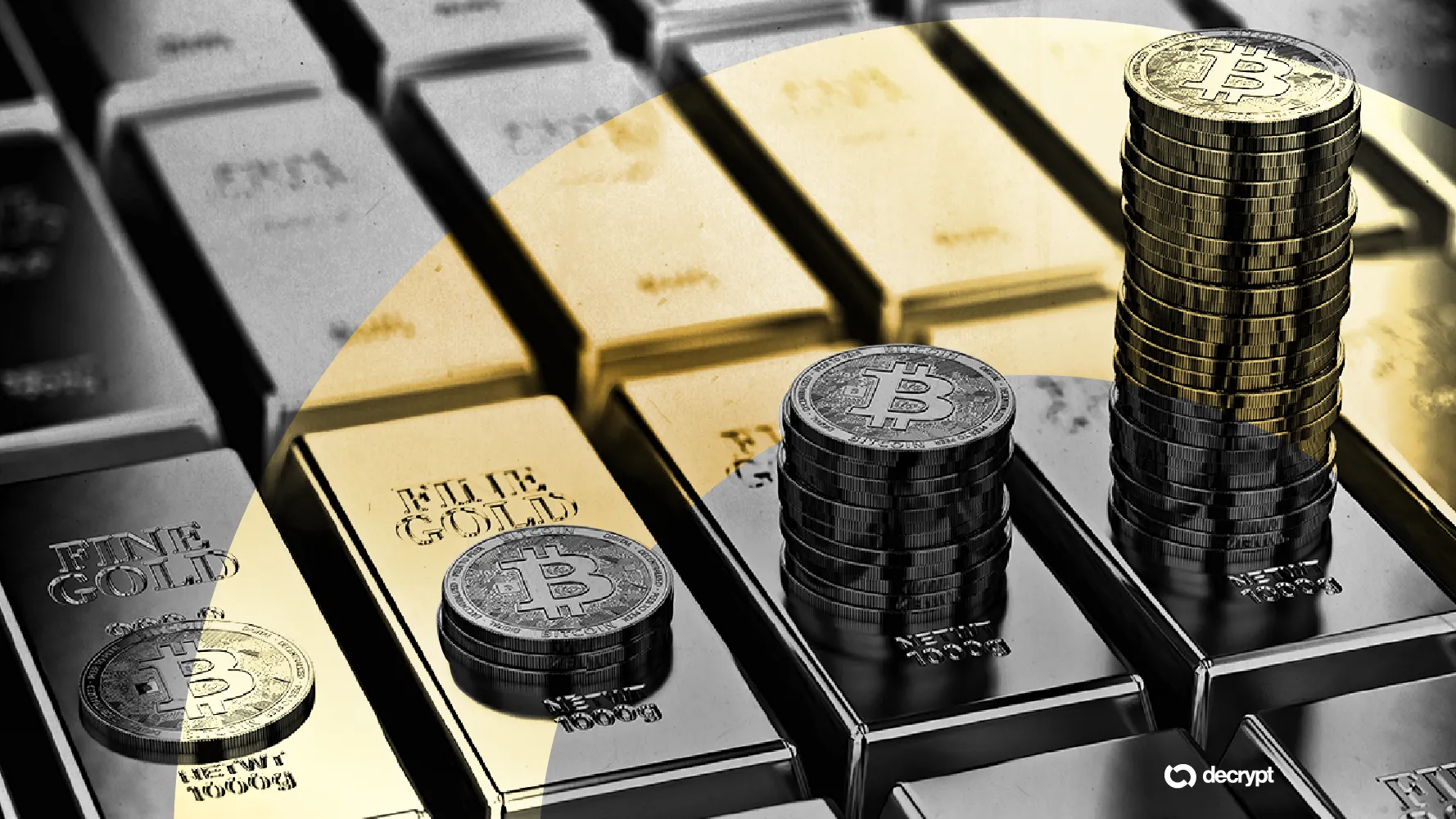

Gold on a Steady Decline, Is it Bitcoin’s Time to Shine?
The allure of gold as the ultimate store of value has been a pervasive narrative for centuries. However, recent trends indicate a steady decline in its status and value, prompting both individual and institutional investors to seek alternative assets. Amidst this shift, the spotlight turns to Bitcoin, often referred to as “digital gold,” which might now be poised to claim some of gold’s long-held market territory.

The Decline of Gold
The decline of gold can be attributed to a combination of factors. Economically, a stronger US dollar and rising interest rates have made gold, which doesn’t offer any interest, less attractive as an investment. Geopolitical stability in key regions also reduces the demand for “safe haven” assets like gold.
Technologically, gold faces challenges in terms of liquidity and divisibility, especially in a digital era where quick and fractional transactions become increasingly crucial. Additionally, the younger generation of investors seems less captivated by gold, perceiving it as an outdated investment compared to newer, more technologically integrated assets.
Rise of Bitcoin
As gold’s appeal diminishes, Bitcoin has begun to capture the attention of investors. Introduced in 2009 as a peer-to-peer electronic cash system, Bitcoin’s underlying technology, blockchain, ensures both security and transparency of transactions. Unlike gold, Bitcoin offers high liquidity and can be bought or sold in fractions at any time of the day, catering to the immediate needs of modern traders.
Furthermore, the limited supply of Bitcoin—capped at 21 million—makes it inherently deflationary, similar to gold. This aspect, combined with the increased adoption by businesses and acceptance by regulators, strengthens its position as a viable alternative to traditional safe-haven assets.
Market Dynamics
The market dynamics also support the rise of Bitcoin at the expense of gold. With major financial institutions and payment platforms integrating Bitcoin, accessibility and usability have surged, reducing the skepticism surrounding its utility and value. Moreover, during recent global crises and inflationary pressures, Bitcoin proved to be a favorable hedge, showcasing potential for high returns.
The volatile nature of Bitcoin is often cited as a drawback. However, its volatility is decreasing as the market matures and more institutional investors get involved. For many, the potential high rewards justify the risks associated with its volatility.
Environmental and Regulatory Challenges
It’s crucial to address the environmental impact of Bitcoin mining, which has been a significant concern due to its heavy energy consumption. However, the industry is seeing a shift towards more sustainable practices and energy sources, potentially mitigating these environmental concerns in the long run.
Regulatory acceptance remains a hurdle, though progress is being made as countries like El Salvador adopt Bitcoin as legal tender and others lay down frameworks to manage and integrate cryptocurrency operations safely.
The Future of Investment
As we navigate through these changing financial landscapes, the dichotomy between Bitcoin and gold highlights a broader shift from traditional to more dynamic, tech-driven investment opportunities. While gold will likely retain some of its luster as a cultural and economic icon, Bitcoin and potentially other cryptocurrencies are paving the way for a new era of digital investment.
The question now is not whether Bitcoin will replace gold entirely but rather how much of the traditional market it can transform. With its growing acceptance and evolving mechanisms, Bitcoin is not only ready to shine but also to redefine what we perceive as “safe” investments in the 21st century.