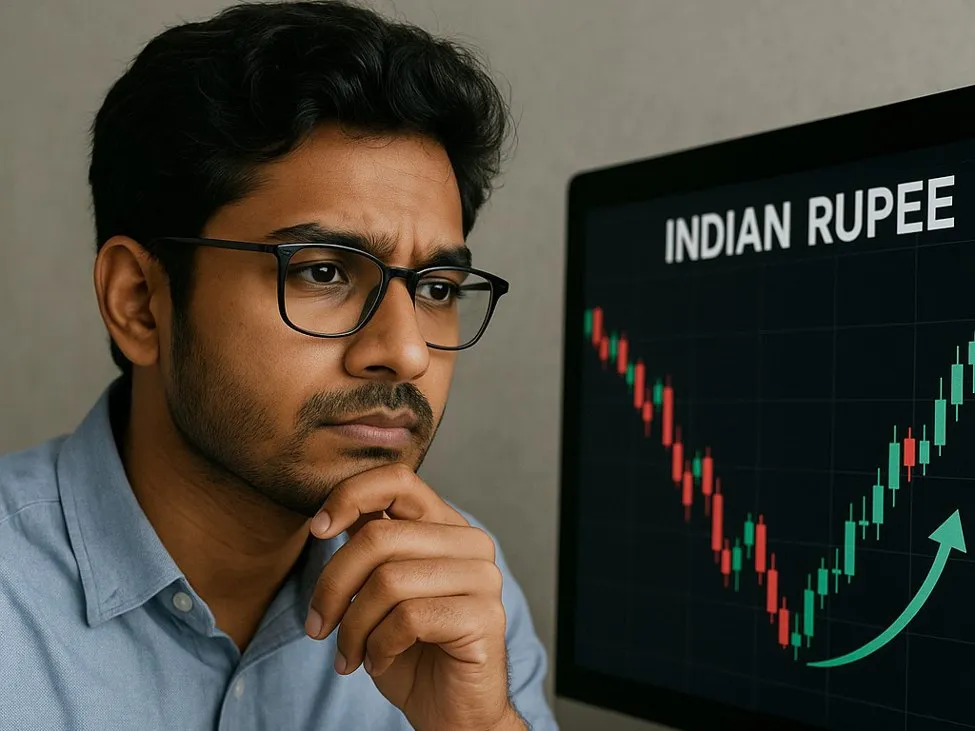

Indian rupee steadies as USD/INR futures rebound off 110–110.50, but conviction remains elusive The Indian rupee held its ground after USD/INR futures rebounded from the 110–110.50 support zone, a move that played out cleanly on the 4-hour chart. Price action still looks corrective rather than a decisive trend change, keeping FX traders focused on range tactics and macro catalysts.
Rupee holds support; bulls still need confirmation
The exchange-quoted USD/INR futures contract respected a well-watched support band at 110–110.50 before bouncing, in line with prior technical calls. Market structure, however, continues to resemble a developing range rather than a V-shaped reversal. After the initial pop, prices have struggled to extend higher, suggesting the rebound may have been a counter-trend leg within a broader consolidation. That keeps directional conviction low and liquidity-sensitive, with spot and futures traders watching whether momentum can build beyond recent swing highs—or if the pair slips back to re-test the lower boundary.
Technical setup on the 4-hour chart
– The recent move validated demand around 110–110.50, where buyers again stepped in. – Despite the bounce, the pattern remains range-like, with successive legs up and down inside a broad consolidation. – A sustained break and close above recent swing highs would be needed to tilt bias decisively upward; conversely, a clean drop below 110–110.50 would indicate renewed rupee strength against the dollar.
Macro drivers to watch
While near-term direction hinges on the technical range, broader cues remain in play: – US Treasury yields and the dollar’s path will set the tone for EM FX risk appetite. – Energy prices remain a key sensitivity for India’s external balances and inflation outlook. – Market chatter around RBI operations can temper intraday volatility and shape expectations for INR stability. – Portfolio flows and month/quarter-end corporate hedging may add noise to otherwise muted volatility.
Key takeaways
- USD/INR futures bounced cleanly from the 110–110.50 support band, validating demand but not confirming a bullish trend shift.
- Price behavior still points to a developing trading range rather than a V-shaped reversal.
- Traders are watching for a break above recent swing highs for upside confirmation—or a loss of 110–110.50 for renewed INR strength.
- Macro inputs—US yields, oil, RBI signaling, and flow dynamics—remain critical for sustained direction.
- Until a breakout, range-bound strategies and disciplined risk management may remain favored.
FAQ
Is the USD/INR move a trend reversal or just a bounce?
The rebound from 110–110.50 looks more like a corrective leg within a broader consolidation. A decisive reversal would need follow-through above recent swing highs; otherwise, the pair risks slipping back into the range.
What levels matter most right now?
The 110–110.50 zone is pivotal support. A clean break below that area would favor rupee strength (lower USD/INR). On the topside, recent swing highs act as initial resistance; a sustained break would be required to confirm bullish momentum in USD/INR.
How are macro drivers influencing the rupee?
US dollar trends, Treasury yields, and oil prices are steering risk appetite for EM FX. Domestic factors—such as RBI operations and corporate hedging flows—can dampen volatility or add intraday noise, influencing how technical levels behave.
What are traders doing in this environment?
With price trapped in a range, many are favoring mean-reversion setups near the edges of the 110–110.50 support and nearby resistance, keeping tight stops. A confirmed breakout would likely shift positioning toward momentum strategies.
Why does this matter for broader markets?
INR stability affects foreign investor sentiment toward Indian assets and can influence local bond yields and equity flows. As USD/INR oscillates within a range, risk appetite remains measured, a theme closely followed by readers of BPayNews.
Related: More from Exchange News | Senate Dems Demand Binance Probe Into FinCtrl in Crypto Exchange | Coinbase Litigation Head: States Gaslight Prediction Markets in Crypto Exchange