
JPMorgan Says Bitcoin’s Path to $170,000 Hinges on MicroStrategy and MSCI, Not Gold

Bitcoin’s longer-run upside remains intact under JPMorgan’s gold-parity model, but traders face nearer-term binary risks: whether MicroStrategy can avoid forced sales and how MSCI rules on crypto-heavy companies in January.
Market context: gold model vs. real catalysts
JPMorgan’s team reiterated a familiar framework that maps bitcoin’s volatility-adjusted market value to gold’s, implying a theoretical price near $170,000 over the medium term if bitcoin continues to “trade like gold.” Yet the bank’s latest analysis stresses the next leg is less about correlations and more about balance-sheet resilience and index eligibility.
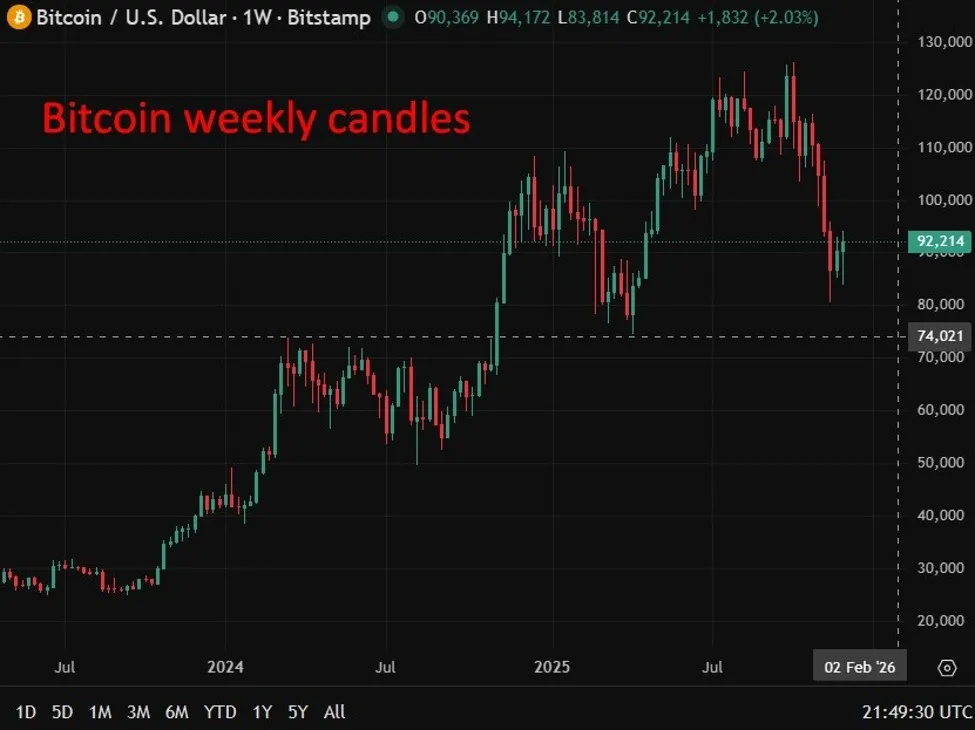
Risk appetite across crypto has weakened amid higher-rate uncertainty into 2026 and a broader risk-off tone that has cooled speculative flows. That backdrop has amplified concentration risk in bitcoin, with MicroStrategy—one of the market’s largest corporate holders—sitting at the center of near-term price stability.
Key Points
- JPMorgan’s volatility-adjusted gold model still implies bitcoin could approach $170,000 over time.
- The bank sees immediate risks anchored in MicroStrategy’s ability to retain its bitcoin and an MSCI ruling on index eligibility.
- MicroStrategy’s mNAV reportedly sits near 1.1; a drop below 1 could trigger sales, per prior management commentary.
- The company has raised $1.4 billion in cash—enough to cover dividends and interest for roughly two years, reducing pressure to liquidate bitcoin.
- MSCI’s January 15 decision on excluding companies with >50% of assets in digital tokens could drive an estimated $2.8 billion in passive outflows if MicroStrategy is removed from major indices.
- A favorable MSCI outcome and no forced selling would likely stabilize sentiment and invite fresh crypto inflows.
MicroStrategy becomes the swing factor
MicroStrategy’s balance sheet has emerged as a real-time gauge for bitcoin stability. Market anxiety has centered on the firm’s modified NAV (mNAV). If mNAV falls below 1, management has hinted that sales could be considered; JPMorgan notes it is around 1.1. The bank also highlights that MicroStrategy has raised approximately $1.4 billion in cash, providing a buffer to meet dividends and interest for about two years—without selling its bitcoin.
Additional pressure has come from reported shifts in holdings. Arkham Intel estimates MicroStrategy’s stash slid from roughly 484,000 to 437,000 tokens in November, stoking concerns about supply hitting the market. JPMorgan’s conclusion: if mNAV remains above 1 and the company avoids liquidation, the market’s worst fears should ease, curbing volatility and helping restore risk appetite.
Index risk: MSCI’s January ruling
Another immediate catalyst arrives on January 15, when MSCI will decide whether to exclude companies that hold more than half of their assets in digital tokens. A negative ruling would eject MicroStrategy from major indices and could trigger around $2.8 billion of passive outflows, according to JPMorgan’s estimate—potentially tightening liquidity and amplifying drawdowns.
Conversely, a green light from MSCI could reduce a major tail risk. JPMorgan argues such an outcome might propel both MicroStrategy’s stock and bitcoin toward pre-October levels and reignite momentum toward prior highs, especially if macro conditions stabilize and dollar strength eases.
What this means for traders
For now, bitcoin’s setup is a tale of two timelines. The medium-term “gold equivalence” narrative remains constructive, but the near-term tape is dominated by event risk and positioning. With broader cross-asset volatility elevated and global yields still a swing factor for risk appetite, traders are likely to react quickly to any signals around MicroStrategy’s balance sheet and MSCI’s methodology.
If MicroStrategy holds the line and MSCI opts for inclusion, the removal of binary overhangs could catalyze renewed inflows, narrower bid-ask spreads, and a rebound in risk-taking across crypto. If either breaks negatively, valuation models will matter less than liquidity dynamics—and bitcoin could remain trapped in a heavier, risk-off regime.
Outlook
JPMorgan’s $170,000 scenario is intact on paper, but the path runs through MicroStrategy and MSCI. For now, those two variables—not gold—are setting the tone. As always, liquidity conditions and rate expectations will steer how aggressively traders press the trade, BPayNews notes.
FAQ
Why is JPMorgan talking about $170,000 for bitcoin?
The bank applies a volatility-adjusted framework that benchmarks bitcoin’s market value to gold. If bitcoin continues to behave like a “digital gold,” that model implies a medium-term price near $170,000.
What is MicroStrategy’s role in bitcoin’s near-term direction?
MicroStrategy is a major corporate holder of bitcoin. JPMorgan argues that its ability to avoid selling—supported by a reported $1.4 billion cash buffer—will be pivotal for market stability and sentiment.
What is mNAV and why does it matter?
mNAV (modified net asset value) compares the firm’s assets to liabilities. MicroStrategy’s mNAV is reportedly around 1.1. If it drops below 1, management has previously suggested sales could be triggered, which could add selling pressure to bitcoin.
What could MSCI’s January decision change?
MSCI will consider excluding companies with more than 50% of assets in digital tokens from major indices. Exclusion could force passive funds to sell, potentially causing about $2.8 billion in outflows from MicroStrategy and weakening crypto-market liquidity.
How could these events affect bitcoin volatility?
Positive outcomes (no forced selling and MSCI inclusion) would likely reduce volatility and tighten spreads. Negative outcomes could amplify volatility as liquidity thins and risk aversion rises.
What are the immediate catalysts traders should watch?
MicroStrategy’s mNAV and cash runway disclosures, any changes in its bitcoin holdings, and MSCI’s January 15 ruling. Broader macro signals—rate expectations and dollar moves—remain key background drivers.