
PBOC sets weakest fix vs expectations since 2022 to slow yuan rally as USD/CNY nears 7.00

China sent one of its clearest signals in years that it wants to cool the yuan’s advance, setting Wednesday’s daily reference rate well weaker than market models as improving risk appetite and a softer dollar push USD/CNY toward the psychologically charged 7.00 handle.
Market highlights
- The People’s Bank of China fixed the yuan at 7.0733 per dollar, about 170 pips weaker than modelled estimates near 7.0554—the largest gap since February 2022.
- USD/CNY is grinding toward 7.00 as sentiment improves on a US–China thaw following a call between Presidents Trump and Xi and talk of a Trump visit to China next year.
- Broader dollar softness tied to US fiscal concerns and inflows into Chinese equities have buoyed the renminbi.
- The fixing surprise suggests Beijing wants to moderate the pace of appreciation to protect export competitiveness and manage liquidity.
- Traders face increased two-way risk near 7.00; daily fixings and offshore CNH price action will be key signals.
Fixing surprise underscores Beijing’s near-term FX priorities
The PBOC’s daily fixing at 7.0733 per dollar came sharply weaker than model-based expectations, indicating an active bias to restrain yuan gains as the currency heads for its best annual run since 2020. The unusually wide gap—the biggest since early 2022—implies stronger use of the central bank’s counter-cyclical tools, a familiar approach when authorities seek to lean against market momentum.
A too-rapid appreciation risks eroding margins for exporters already contending with uneven global demand. It can also tighten domestic financial conditions by encouraging capital inflows and pressuring liquidity. By telegraphing a preference for a slower ascent, the PBOC appears to be balancing improving sentiment with macro stability.
Macro backdrop: thaw, flows and a softer dollar
Improved US–China dialogue—highlighted by a leaders’ call and the prospect of a visit by President Trump next year—has helped ease geopolitical risk premia. At the same time, a softer dollar linked to US fiscal worries has reduced broad USD support across G10 and EM FX. These crosscurrents, alongside fresh inflows to Chinese equities as risk appetite firms, have driven the renminbi stronger in recent sessions.
The result is a classic policy juncture: allow market forces to push the yuan through a key psychological level, or signal restraint to prevent a one-way trade. Wednesday’s fixing suggests authorities prefer the latter, at least for now.
Market reaction and trading implications
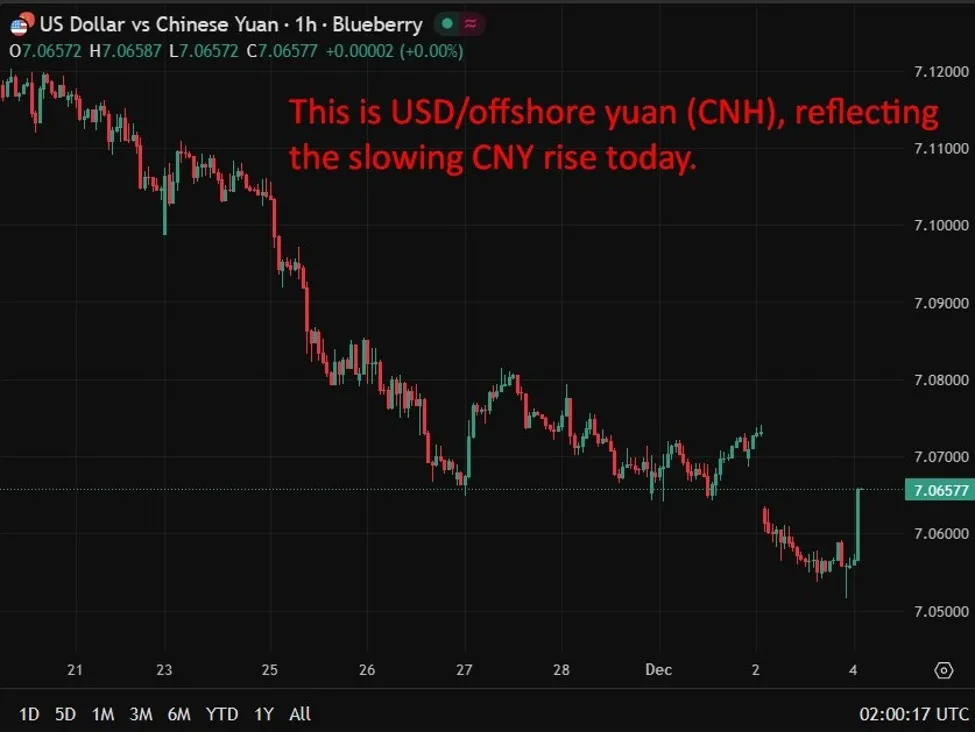
– Spot USD/CNY and offshore USD/CNH remain anchored near 7.00, with two-way interest evident as real-money and exporter flows meet short-dollar positioning.
– The stronger fixing bias may cap near-term yuan gains and keep USD/CNY oscillating around the 7.00 figure, a level watched by options markets and corporate hedgers.
– Expect tighter intraday ranges around the fix and heightened sensitivity to headlines on US–China relations, Chinese equity flows, and US rate expectations.
Why it matters for traders
For FX participants, the PBOC’s stance can skew risk-reward. A persistent weaker-than-expected fix typically limits appreciation and can re-anchor topside USD/CNY/CNH levels. For equity and rates traders, a slower yuan rally supports export-facing shares and reduces pressure for rapid easing or liquidity injections. That said, if global dollar weakness reasserts, the PBOC may need repeated signals to keep the pace of yuan gains measured.
What to watch next
– The next several daily fixings for consistency of the signal and tolerance for spot trading near 7.00.
– Offshore CNH behavior versus onshore CNY for signs of spillover pressures and any widening basis.
– Portfolio flow data into Chinese equities and bonds, and any incremental guidance from Chinese policymakers.
– US fiscal headlines and yield dynamics that could re-strengthen or further soften the dollar.
As BPayNews notes, the mix of policy signaling and improving risk sentiment sets up a tactical battleground around 7.00 with elevated two-way risk and an active role for the fixing in steering expectations.
FAQ
Why did the PBOC set the yuan fix weaker than expected?
The weaker-than-expected fix signals a desire to slow the yuan’s appreciation amid improved sentiment and dollar softness. It helps safeguard export competitiveness and manage domestic liquidity by discouraging a one-way strengthening trend.
Why is the 7-per-dollar level important?
The 7.00 handle is a psychological and technical pivot watched by corporates, asset managers, and options markets. Price action around this level can influence hedging behavior, volatility, and short-term capital flows.
How does a weaker fix affect USD/CNH and USD/CNY trading?
A weaker fix typically supports the dollar versus the yuan, capping appreciation momentum. It can keep USD/CNY and USD/CNH range-bound near key levels, increase two-way trade, and reduce the likelihood of a swift break below 7.00 without fresh catalysts.
What are the main drivers of the yuan right now?
Improved US–China relations, inflows into Chinese equities, and broad dollar softness tied to US fiscal concerns are supporting the yuan. Policy signals from the PBOC via the daily fix are acting as a counterweight to prevent a rapid climb.
Does this change the medium-term outlook for the renminbi?
Not necessarily. The signal is about pacing, not direction. If global risk appetite stays firm and the dollar remains soft, the yuan could still appreciate over time—but likely in a controlled, two-way fashion guided by the fix.