
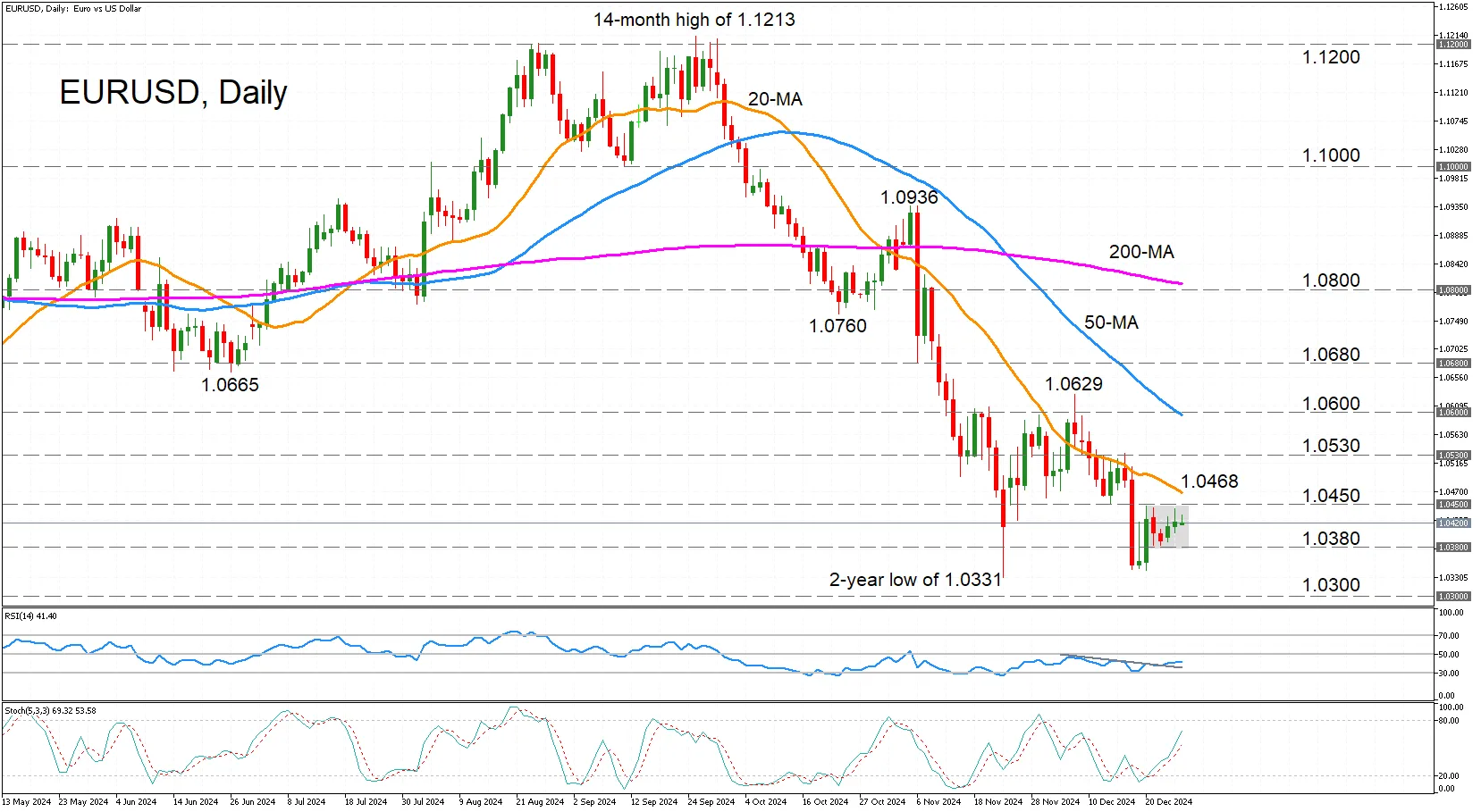

EURUSD Technical Analysis: The Greenback Fails to Extend Gains on Strong Data
Key Takeaways
In the world of forex trading, the EURUSD pair, representing Euros to United States dollars, is arguably the most scrutinized and traded currency pair. Today, we delve into recent movements as the USD (United States Dollar) shows uncharacteristic restraint in capitalizing on robust economic indicators, leading to an intriguing technical setup.
Contextual Background
The dollar has recently faced an uphill battle despite the release of strong U.S. economic data, typically a catalyst for bullish momentum. Instead, the greenback has struggled to make significant gains against the euro. This counterintuitive market behavior invites a deeper exploration into the technical and possible external factors influencing this trend.
Technical Analysis
Key Levels
From a technical standpoint, the EURUSD pair showcased fascinating dynamics. After hitting a low of 1.0700 earlier in the week, the pair rebounded sharply, touching a high of 1.0925. The resistance near 1.0950 has proven formidable, capping upside potential in the short term. Conversely, support lines are traced around the 1.0850 marker, a breach of which could signal a bearish sentiment shift.
Moving Averages
The 50-day and 200-day moving averages provide further insights. The EURUSD is currently trading between these moving averages, which act respectively as temporary support and resistance. Notably, the 50-day moving average just below the current trading price suggests that short-term momentum could still favor the bulls.
RSI and MACD
The Relative Strength Index (RSI), hovering around 55, indicates neither overbought nor oversold conditions, presenting a neutral momentum scenario. Meanwhile, the Moving Average Convergence Divergence (MACD) shows a slight bullish crossover but remains close to the baseline, confirming the market’s uncertainty.
Fundamental Insights
Analyzing why the dollar’s response to strong data—such as improved GDP growth, lower unemployment rates, or favorable consumer confidence indices—has been muted, several theories emerge. Investors might be weighing other global economic uncertainties, like geopolitical tensions or divergent central bank policies, more heavily against domestic indicators. Moreover, concerns about inflation and the Federal Reserve’s cautious stance on interest rates may be tempering the enthusiasm for the greenback.
Market Sentiment and External Factors
The sentiment in the forex markets is also swayed by broader market dynamics. Investors’ appetite for risk, driven by global economic news and cross-market flows, plays a critical role. Currently, there appears to be a risk-averse sentiment, possibly pushing traders towards the perceived safety of the euro in uncertain times.
Forward-Looking Perspectives
Looking ahead, traders will closely monitor incoming economic data and central bank communications. Key events that could significantly impact the EURUSD trajectory include policy announcements from the European Central Bank (ECB) and the Federal Reserve, along with major economic releases from both economies.
Conclusion
In conclusion, while strong U.S. data typically fuels dollar strength, current market dynamics and global uncertainties have curbed this trend. As traders, staying abreast of both technical indicators and macroeconomic developments will be crucial in navigating the future EURUSD movements. The coming weeks promise to be packed with actionable insights as new data comes to light, potentially reshaping market sentiment and forex dynamics conclusively.
Related: More from Market Analysis | Middle East Tensions Lift CRCL Shares Amid Rate in Crypto Market | Dollar Rise Weighs on Cryptos, Gold in Crypto Market