


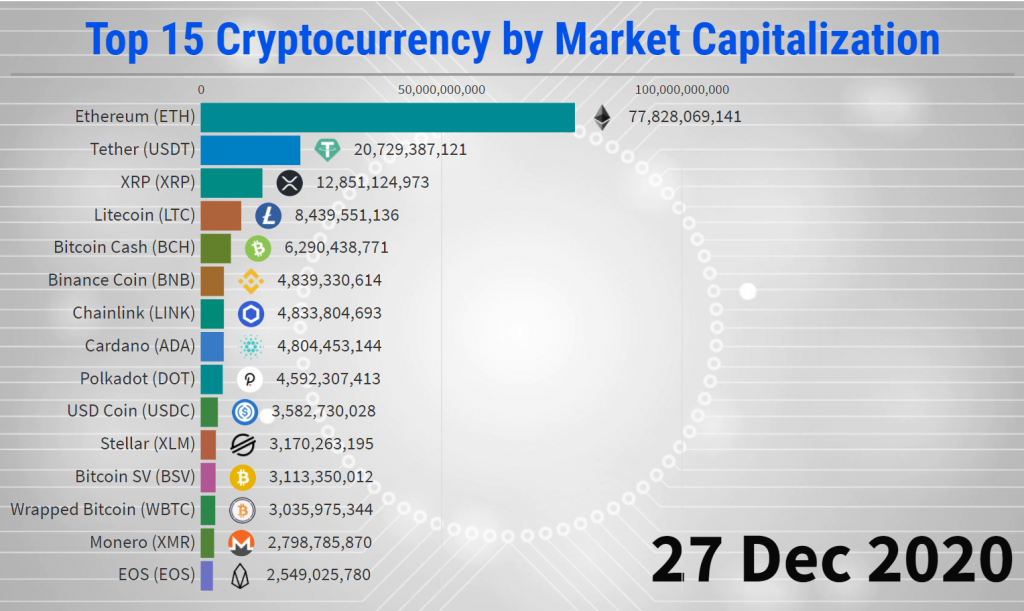

Ethereum market capitalization has emerged as a pivotal measurement in the crypto landscape, signifying the overall value of the Ethereum blockchain as compared to its competitors. As of early January 2026, Ethereum holds a staggering 59% of the total value locked (TVL) across cryptocurrencies, demonstrating its dominance and investor confidence. However, its ETH token’s market capitalization only represents 14% of the entire crypto market cap, highlighting a notable discrepancy and potential undervaluation. This contrasts sharply with platforms like Solana and Tron, illustrating how the Ethereum market cap continues to evolve amidst ongoing discussions in the crypto community, particularly regarding Solana comparison and BNB Chain analysis. With rising interest in the crypto market cap dynamics, understanding Ethereum’s position becomes crucial for investors looking to capitalize on its unique opportunities.

The value of Ethereum in the digital asset market is often analyzed through various lenses, including its total market valuation relative to total value locked in decentralized finance protocols. As such, the Ethereum ecosystem exhibits intriguing metrics that set it apart from other platforms like Solana and Tron. Investors frequently examine these figures to assess Ethereum’s positioning among altcoins often analyzed through the lens of BNB Chain’s performance and broader market trends. Recent statistics indicate a significant imbalance in Ethereum’s financial metrics, prompting discussions on what this might mean for future investments. Whether investors are engaged in a Tron vs Ethereum debate or evaluating the insights from other blockchain ecosystems, the importance of these analytics cannot be overstated.
Understanding Ethereum’s Market Capitalization vs Total Value Locked (TVL)
Ethereum remains a dominant force in the cryptocurrency space, maintaining a staggering percentage of the total value locked (TVL) in relation to its market capitalization. Holding a commanding 59% of the entire crypto market’s TVL, Ethereum’s Ether (ETH) token is paradoxically undervalued, contributing to only 14% of the total crypto market cap. This discrepancy highlights a remarkable inversion in Ethereum’s valuation metrics, suggesting that the market may not fully appreciate the underlying value and usage of Ethereum’s network. Investors and analysts closely observe this gap as it presents a compelling argument for potential future growth, emphasizing that Ethereum’s robust ecosystem is not yet reflected in its market cap valuations.
Furthermore, this contrast is particularly noticeable when compared to other blockchain platforms such as Solana and TRON. While Solana’s market cap stands at a mere 3% compared to its TVL of 7%, and TRON shows a similar trend with values of 1% and 3.7% respectively, Ethereum’s sustainable growth pattern indicates a healthier operational foundation. This substantial difference in market cap relative to TVL could signify a golden opportunity for investors looking to capitalize on Ethereum’s inevitable market correction and revaluation.
Moreover, the token market capitalization/TVL ratio serves as a critical lens through which to assess the relative health of blockchain ecosystems. In the face of increased competition from networks like Solana, which has rapidly gained traction but still showcases a less favorable ratio, Ethereum’s position could be interpreted as an indicator of potential appreciation. BNB Chain, with a 4.5% market cap against a 5.5% TVL, also presents an intriguing comparison, although it still lags behind Ethereum in terms of ecosystem diversity and application. By carefully analyzing these ratios, potential investors can draw informed conclusions about where to allocate their resources in the crypto landscape, understanding that Ethereum currently stands at a strategic advantage due to its established network and comprehensive range of decentralized applications.
Comparative Analysis: Ethereum, Solana, and Tron
When comparing Ethereum with other blockchain platforms like Solana and Tron, it becomes essential to evaluate their respective total value locked (TVL) and market capitalization metrics comprehensively. Ethereum’s impervious hold on the majority of TVL not only emphasizes its predominance but also raises questions about the relative valuation of its native token, Ether (ETH). Solana, while innovative and seeking to address scalability issues, struggles with its market cap/TVL ratio, thereby illustrating its vulnerability in comparison. With Solana’s market cap at only 3%, its sustainability and reliability as an investment come into question. On the other hand, Tron’s approach appears similarly flawed, demonstrating further evidence of how decentralized finance (DeFi) projects can diverge significantly in terms of trust and adoption within the crypto community.
The comparative analysis suggests that Ethereum’s well-established infrastructure ultimately yields a stronger foothold against competitors like Solana and Tron. While those ecosystems aim to provide faster transaction times and lower fees, they lack the extensive developer engagement and ongoing innovation that Ethereum continuously showcases through updates and enhancements. Thus, despite the numbers reflecting a rapid rise for other blockchains, the robustness of the Ethereum ecosystem remains unparalleled, fortifying its position not just as a marketplace for cryptocurrency but as a foundation for the future of decentralized applications.
In an emerging market filled with contenders, the differentiation in TVL versus market cap serves as an insightful narrative for future investment strategies. As Ethereum progresses along this uneven landscape, examining the myriad factors influencing its valuation—including overall adoption rates, technological advancements, and community support—will be pivotal for understanding its trajectory in relation to newcomers such as Solana and established figures like Tron. Investors keen on practical insights would do well to note that, while immediate comparisons might initially promote more nascent platforms, the long-term viability of Ethereum is supported by a robust ecosystem, setting it apart as a preferred choice in an era of innovation and rapid development within the cryptocurrency domain.
Tron vs Ethereum: A Clash of Ecosystems
In the ongoing debate between Tron and Ethereum, it’s paramount to consider not just their technological foundations but also their respective market dynamics. Ethereum has cemented itself as the backbone of smart contracts and decentralized applications, boasting a significantly higher total value locked (TVL) compared to its market capitalization. In stark contrast, Tron demonstrates a more fluctuating market cap that does not nearly match its TVL. This discrepancy calls into question the sustainability and future growth prospects of Tron amidst increasing competition in the crypto market. The lack of a diverse ecosystem equivalent to Ethereum’s may hinder Tron’s ability to scale and adapt in the face of rapid technological advancements and shifting user preferences.
Moreover, the ongoing investment focus on DeFi projects offers greater insights into how institutional and retail investors evaluate potential returns. Ethereum’s flourishing DeFi scene, facilitated by its vast number of developers and projects, reflects a reliable structure fostering confidence among users. As a result, assessing the long-term viability of Tron compared to Ethereum requires not only a glance at their current operational metrics but also an analysis of the adaptability and outreach of each platform within the ever-changing landscape of blockchain technology.
The competition between Tron and Ethereum also highlights the evolving narrative within the crypto space, where agility and user engagement remain critical components of success. While Tron positions itself as a competitor by enabling quick transactions and incentivizing user participation, Ethereum’s resilient approach rooted in community collaboration and extensive application development continues to yield significant advantages. The current metrics related to token market cap versus TVL showcase the disparity in perceived value between the two networks, suggesting that investors might lean toward Ethereum as a more promising long-term asset. Hence, it becomes clear that the evolution of blockchain technology will be dictated not merely by immediate prowess but by a sustained commitment to growth, innovation, and community involvement, with Ethereum poised to lead the charge.
Analyzing BNB Chain Against Ethereum
The BNB Chain has emerged as a significant player in the blockchain ecosystem, often seen as a direct competitor to Ethereum due to its lower transaction costs and scalability features. However, when scrutinizing the comparative metrics of token market capitalization versus total value locked (TVL), significant questions arise regarding BNB Chain’s long-term sustainability in attracting developers and projects. Although BNB Chain boasts a market cap/TVL ratio of 4.5%/5.5%, the foundational strength of Ethereum, with its 59% hold on TVL at a 14% market cap valuation, lays bare the challenges faced by BNB Chain in securing a prominent place in the crypto market truly.
Furthermore, the prevalence of Ethereum’s adaptability through frequent upgrades and its established position as a leader in decentralized finance continues to outshine BNB Chain, which may appear attractive due to its low fees but lacks the extensive developer toolkit that Ethereum nurtures. Investors evaluating long-term asset stability will need to weigh these factors carefully, recognizing that while BNB Chain may offer competitive advantages in speed and cost, the robustness of Ethereum’s ecosystem and its commitment to innovation position it as a far more attractive investment opportunity.
Ultimately, Ethereum’s technological foundation, community support, and extensive range of decentralized applications continue to differentiate it from BNB Chain, particularly as both networks strive to cater to similar user bases. The current landscape emphasizes Ethereum’s capacity to foster a thriving DeFi ecosystem and maintain a dominate share of the TVL across the industry. Investors interested in comparing BNB Chain to Ethereum must focus on the undercurrents that dictate each platform’s sustainability while also keeping an eye on emerging technologies that could shift the balance in the crypto market. In this ongoing race, Ethereum’s entrenched stature combined with its adaptive innovation seems to place it at the forefront of the sector.
Frequently Asked Questions
What is Ethereum’s market capitalization and how does it compare to its total value locked (TVL)?
Ethereum’s market capitalization currently accounts for only 14% of the total cryptocurrency market capitalization, despite holding a dominant 59% share of the total TVL in the crypto market. This significant disparity indicates that Ethereum’s market cap may be undervalued compared to its TVL.
How does Ethereum’s market capitalization/TVL ratio compare to Solana’s?
Ethereum’s market capitalization/TVL ratio is notably lower than that of Solana. With Ethereum’s ratio being around 14% of the market compared to Solana at 3% market cap against a TVL of 7%, it highlights Ethereum’s relative undervaluation in comparison to its total value locked blockchain ecosystem.
What insights can be drawn from Ethereum’s market capitalization relative to its competitors like Tron and BNB Chain?
When comparing Ethereum’s market capitalization to Tron and BNB Chain, the differences are stark. Ethereum’s market cap/TVL ratio is just 14%, while Tron’s ratio is 1% against a TVL of 3.7%, and BNB Chain stands at 4.5% market cap to 5.5% TVL. This emphasizes Ethereum’s significantly lower market cap in relation to its TVL, marking it as a potentially undervalued asset.
Why is Ethereum considered undervalued based on its current market capitalization and TVL?
Ethereum is viewed as undervalued due to the current discrepancy between its market capitalization and the massive total value locked (TVL) on its blockchain. Holding 59% of the total TVL in the crypto market while only representing 14% of the total market capitalization suggests that Ethereum’s token, ETH, may not be accurately priced relative to its actual usage and liquidity.
How do Ethereum’s market capitalization figures impact investor perception compared to Solana, Tron, and BNB Chain?
Ethereum’s substantial market capitalization disparities compared to Solana, Tron, and BNB Chain may affect investor decisions, as it showcases Ethereum’s solid foundational network yet relatively low valuation. Investors might see this as an opportunity to buy into a blockchain that is fundamentally strong but currently undervalued compared to its competitors.
| Blockchain | Market Capitalization (% of Total Market Cap) | Total Value Locked (TVL) (% of Total TVL) | Market Cap/TVL Ratio |
|---|---|---|---|
| Ethereum | 14% | 59% | 0.24 |
Summary
Ethereum market capitalization reveals a significant disparity when compared to its total value locked (TVL) ratio, indicating that it is currently undervalued in the blockchain space. According to recent information, Ethereum holds 59% of the total TVL in crypto markets while its market capitalization represents only 14% of the total cryptocurrency market. This stark contrast highlights Ethereum’s potential for growth and suggests that it may be a formidable investment option compared to other blockchains like Solana, TRON, and BNB Chain.