


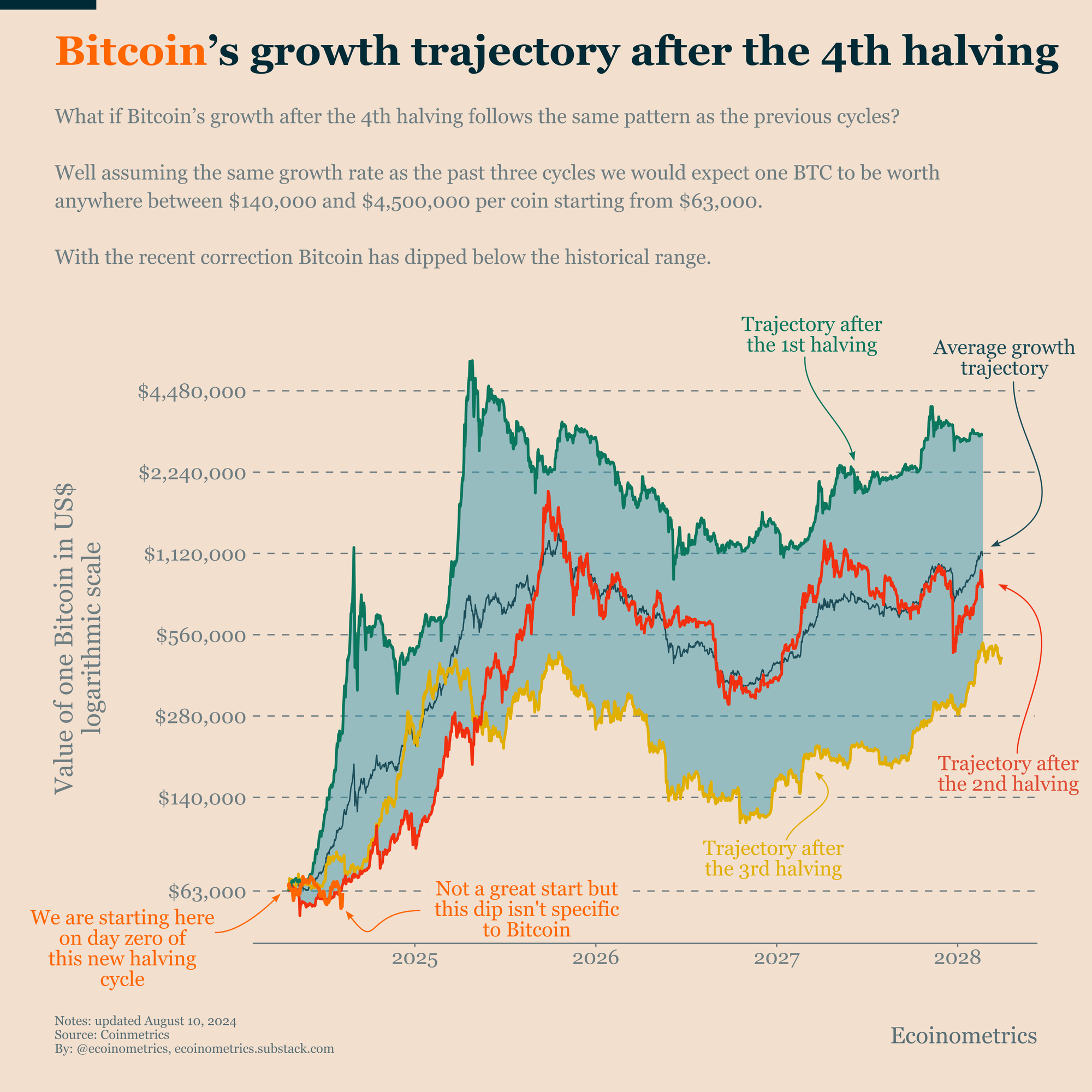

Bitcoin‘s trajectory is generating significant buzz in the investment community as experts draw parallels between its current movement and the S-curve famously associated with the rise of the internet. Recently, Jurrien Timmer, Fidelity’s Director of Global Macro, emphasized this comparison, suggesting that the cryptocurrency might be entering a critical consolidation phase. As market enthusiasts speculate on Bitcoin’s price prediction, some believe this phase could place the asset on a trend line approaching $65,000, a crucial threshold that could dictate its future. Skepticism remains, particularly surrounding the persistent bear market theory, but the sentiment of many advocates hints at a structural upturn on the horizon. Overall, understanding Bitcoin’s trajectory is essential, especially as it navigates the challenges and opportunities presented in the current economic landscape.

The path of Bitcoin is a hot topic among economic analysts and cryptocurrency enthusiasts alike, especially as it echoes the growth patterns seen in revolutionary technologies. Recent discussions have highlighted its potential alignment with the internet’s rise rather than following a more erratic power-law curve. Analysts, including Jurrien Timmer from Fidelity, are closely monitoring Bitcoin’s movement, especially as it faces what could be a pivotal consolidation phase. Speculations around its price point underscore the possibility of reaching heights around $65,000, marking an important juncture in the market. As conversations about Bitcoin’s future unfold, the dynamics of bear market theories and structural growth signal the importance of informed investment strategies.
Bitcoin’s Trajectory Resembles the Internet’s S-Curve
In a recent assertion, Jurrien Timmer, Fidelity’s Director of Global Macro, emphasized that Bitcoin’s trajectory closely aligns with the S-curve pattern observed during the growth of the internet. This model showcases how innovative technologies experience slow adoption at first, followed by exponential growth as they find mainstream acceptance. Timmer suggests that if Bitcoin can proceed through its current uncertainty, it could mirror the internet’s evolution, ultimately positioning itself as a dominant digital asset on the world’s stage.
This S-curve illustrates the potential for Bitcoin’s long-term growth trajectory, moving past traditional volatility to establish a more substantial foothold in the financial markets. If Bitcoin does indeed transition into a consolidation phase, as suggested, it may set the stage for significant price movements in the foreseeable future. Investors and analysts alike are keenly observing these patterns, drawing parallels between past technological advancements and Bitcoin’s unfolding narrative.
Navigating Bitcoin’s Current Consolidation Phase
As Bitcoin undergoes its consolidation phase, market participants are debating its implications on price trajectories. Historical trends indicate that consolidation often precedes major price shifts. In this context, Timmer’s insights hold considerable weight, especially considering that a future consolidation may either reinforce Bitcoin’s legitimacy or challenge its perceived value. Currently, Bitcoin is seen hovering at critical resistance levels, with speculation mounting around how it will react to various market conditions.
The consolidation phase represents a pivotal moment for Bitcoin, akin to a reset that could either reaffirm investor confidence or signal deeper corrections. Should Bitcoin sustain its position around the previous high of $65,000, it may solidify the argument against the bear market theory that some analysts uphold. However, if external pressures push the price lower, it could validate concerns about an impending downturn, highlighting the ever-present need for caution in cryptocurrency investments.
Implications of the Bear Market Theory on Bitcoin
The bear market theory posits that every crypto asset must undergo downside corrections after periods of rapid price rises. Timmer challenges this theory by providing a more nuanced view of Bitcoin’s market dynamics, suggesting that while pullbacks are natural, they may not necessarily indicate the end of a long-term bullish trend. This perspective has resonated with many who believe in Bitcoin’s potential as a revolutionary asset, countering the pessimistic outlook of prolonged bear markets.
With the growing sentiment that Bitcoin may have reached a turning point in its maturation process, it becomes increasingly critical to assess the factors driving its price movements. The community is keen on understanding the role of institutional investments, market sentiment, and regulatory landscapes that could underpin or undermine Bitcoin’s trajectory. As discussions continue around the bear market theory, the overall consensus appears to lean toward optimism, especially among those witnessing Bitcoin’s increasing legitimacy.
Fidelity’s Outlook on Bitcoin Price Predictions
Fidelity’s Jurrien Timmer has taken an analytical stance on Bitcoin price predictions, situating them within broader market trends. His commentary suggests that while the cryptocurrency exhibits volatility, there is a fundamental growth potential defined by its unique market structure. This perspective invites institutional investors to reevaluate Bitcoin not just as a speculative asset but as a growing financial instrument worthy of consideration within diversified portfolios.
Moreover, with discussions of Bitcoin price predictions fueled by advancements in technology and increasing user adoption, it becomes evident that traditional models may not apply straightforwardly to the crypto space. The implementations of financial products linked to Bitcoin could lead to price stabilization, fundamentally altering how market participants approach future investments.
The Role of Institutional Investors in Bitcoin’s Future
The entrance of institutional investors into the Bitcoin landscape has been a game-changer, altering perceptions and realities surrounding cryptocurrency investments. With large financial entities like Fidelity signaling confidence in Bitcoin’s potential, the market has seen a gradual shift towards more strategic financial approaches. The backing from these institutions not only provides capital but also enhances the legitimacy of Bitcoin as a credible asset class.
As more institutional players engage with Bitcoin, the overall landscape may pivot from one dominated by retail speculation to one where more strategic and long-term investment plays prevail. This shift could reinforce Bitcoin’s position within financial markets and lead to more pronounced price stability, potentially mitigating extreme market fluctuations while fostering an environment for growth.
Understanding Bitcoin’s Historical Cycles
Bitcoin has historically operated in cycles, marked by periods of intense bullish growth followed by corrections. Recognizing these cycles is vital for predicting future behavior, particularly as opinions diverge on whether Bitcoin is entering a new structural phase or simply repeating patterns from its past. The analysis presented by Timmer, combined with observed trends, suggests we may be on the brink of a new paradigm for Bitcoin’s price trajectory.
The four-year cycle commonly referenced in Bitcoin discussions has led many to anticipate a new upsurge after previous downturns. However, caution remains as the market doesn’t always adhere to predictable patterns. Understanding past cycles can provide insightful context for interpreting current conditions and making informed decisions for future investments.
Bitcoin’s Future in a Post-Bear Market Scenario
Should Bitcoin successfully transition from its current consolidation phase into a post-bear market scenario, the implications could be profound. Analysts speculate a price point close to $65,000 as pivotal, marking the potential to reinvigorate bullish sentiment. Observers argue that achieving this level could lead to a sustained upward trajectory allowing Bitcoin to reclaim its position at the forefront of digital currency evolution.
The potential for Bitcoin to evolve beyond previous bear market lows presents an intriguing landscape for both current and prospective investors. With historical highs acting as benchmarks and psychological resistance points, the journey towards future price peaks demands close attention to market dynamics and investor behavior moving forward.
The Impact of Market Sentiment on Bitcoin
Market sentiment has a profound impact on Bitcoin’s price and acceptance. Timmer’s insights underscore the importance of psychological factors driving investor behavior, particularly during times of uncertainty. A positive outlook, bolstered by developments within the crypto ecosystem and institutional buy-ins, can create a momentum effect, driving prices higher as confidence builds.
Conversely, negative news or economic downturns can trigger rapid sell-offs, reflecting the volatility inherent in Bitcoin investments. Understanding these dynamics is crucial for investors seeking to navigate Bitcoin’s fluctuating landscape. By assessing sentiment alongside other market indicators, participants can better position themselves to capitalize on opportunities as they arise.
Technological Innovations and Bitcoin’s Growth
Technological advancements play a critical role in enhancing Bitcoin’s viability as an asset. Innovations such as quicker transaction processes, enhanced security protocols, and improved user interfaces have made Bitcoin increasingly accessible to everyday users. This evolution is vital for attracting new investors and integrating Bitcoin into more extensive financial systems.
As Bitcoin’s technology continues to improve, the potential for broader adoption also rises. Investors are urged to consider these technological shifts in their market analysis, predicting that as use cases for Bitcoin expand, so too will its valuation and stability. A robust technological framework can provide the foundation necessary for Bitcoin to maintain its trajectory in the coming years.
Final Thoughts on Bitcoin’s Market Dynamics
In summarizing the current discourse on Bitcoin, it is evident that numerous factors will influence its trajectory in the coming months and years. Analyst insights, particularly from figures like Timmer, lend credence to the notion that the future of Bitcoin is intertwined with both historical patterns and emerging trends in market behavior. Understanding these dynamics aids investors in forming a clearer picture of Bitcoin’s potential path forward.
Ultimately, the intersection of market sentiment, technological innovations, and institutional involvement will shape Bitcoin’s future. Whether it adheres to the S-curve model or ventures into uncharted territory remains to be seen, but the evolving landscape signals a compelling narrative for Bitcoin and those looking to invest in its future.
Frequently Asked Questions
What is the Bitcoin trajectory according to Fidelity’s Director of Global Macro?
Fidelity’s Director of Global Macro, Jurrien Timmer, suggests that Bitcoin’s trajectory resembles the Internet’s S-curve rather than a typical power-law curve. This comparison implies that Bitcoin’s growth may enter a consolidation phase, influencing future price predictions.
How does the Bitcoin S-curve impact price predictions?
The Bitcoin S-curve indicates that as adoption increases, Bitcoin’s price may stabilize before initiating significant upward momentum. If Bitcoin enters a consolidation phase, this could lead to price predictions aligning with the power-law trend line, potentially reaching $65,000.
What is the significance of the bear market theory for Bitcoin’s trajectory?
The bear market theory suggests that while Bitcoin has historically experienced downturns, its current trajectory may escape traditional patterns. Jurrien Timmer is skeptical that bear markets will disappear entirely, indicating a cautious approach to Bitcoin’s future price fluctuations.
Can you explain the consolidation phase in Bitcoin’s trajectory?
The consolidation phase in Bitcoin’s trajectory refers to a period where Bitcoin’s price stabilizes before making significant moves. Timmer highlights this phase as crucial, especially if Bitcoin maintains its position above key levels like $65,000.
How does the four-year cycle relate to Bitcoin’s trajectory and future price expectations?
Many Bitcoin enthusiasts argue that the traditional four-year cycle is ending, indicating a potential new structural uptrend in Bitcoin’s trajectory. This perspective aligns with forecasts that Bitcoin could move towards higher price levels beyond historical cyclical patterns.
What are the predicted price levels for Bitcoin based on its current trajectory?
Based on Jurrien Timmer’s analysis, if Bitcoin maintains its current trajectory, it may test the power-law trend line at around $65,000 as a crucial resistance level, while the lower bottom is projected at $45,000.
How does Jurrien Timmer’s analysis affect Bitcoin price predictions?
Jurrien Timmer’s analysis, which places Bitcoin’s trajectory in line with the S-curve, could influence market sentiment and adjust expectations, particularly regarding long-term price stability and potential breakout points.
| Key Points |
|---|
| Jurrien Timmer, Fidelity’s Director of Global Macro, suggests Bitcoin’s trajectory resembles the S-curve of the internet. |
| The potential consolidation phase may see Bitcoin approaching a price point around $65,000. |
| Bitcoin supporters believe the traditional four-year cycle has ended, indicating a looming upsurge. |
| Timmer is skeptical about claims of an end to bear markets, considering the influence of historical halving cycles. |
| Current price benchmarks include a bottom line of $65,000 and a power-law trend line projected bottom of $45,000. |
Summary
The Bitcoin trajectory is shaping up to be a critical point of discussion among investors and analysts. With perspectives likening it to the internet’s S-curve, there’s a possibility of significant price movements in the near future. As the market navigates through various cycles, understanding these dynamics is essential for those looking to invest in Bitcoin. As we prepare for possible consolidation phases and price benchmarks, careful monitoring of Bitcoin’s performance could prove vital for anticipating future trends.
Related: More from Bitcoin News | Bitcoin Analysts: BTC Market Bottoming in Q4 2026 | BTC Below $70K, JPN Inflation Under 2%: Monthly Charts