

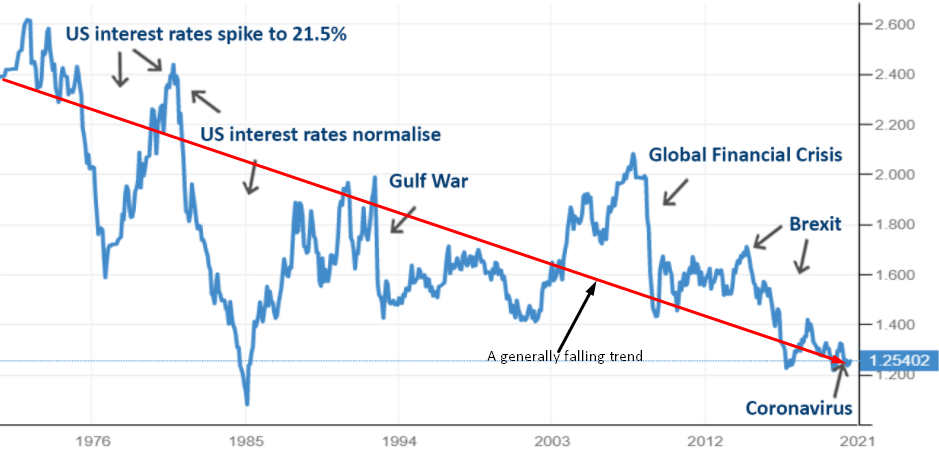

When discussing GBP vs USD, it’s essential to understand the nuances of currency exchange rates in today’s global economy. The disparity in value between the British Pound and the U.S. Dollar can often evoke confusion, especially with the historical implications of purchasing power parity at play. Recent inflation impacts in the UK have prompted discussions regarding the economic outlook for the GBP, while USD dominance remains a critical factor in international finance. As these two currencies interact in the foreign exchange market, their fluctuating values reflect a complex web of macroeconomic influences. Understanding how these dynamics affect GBP vs USD is crucial for investors and travelers alike, as it ultimately shapes their purchasing power.
In the realm of international finance, comparing the British Pound to the American Dollar reveals many insights into their economic relationship. The fluctuations in their values demonstrate the wider implications of currency performance amid inflationary trends in the UK and the overarching dominance of the U.S. Dollar. By examining interest rates, market sentiment, and trade dynamics, it’s clear that the comparison extends beyond mere exchange rates to encompass broader economic health. As one navigates through the intricacies of GBP to USD ratios, grasping the interconnections of currencies within the global marketplace becomes vital. This exploration aids in understanding how each currency’s relative strength shapes purchasing power parity and influences consumer behavior across borders.
| Key Points | Details |
|---|---|
| Paradox of Currency Values | Despite GBP being valued higher than USD, it does not directly correlate with economic strength. |
| Understanding Currency Pairs | GBP/USD reflects the price of GBP in USD, not the economic power of the UK vs. the US. |
| Expectation in Economics | Interest rates, inflation, growth, and capital flows are major factors influencing GBP/USD. |
| Purchasing Power Parity (PPP) | Spot currency quotes are different than actual purchasing power; GBP can buy more than USD despite lower numerical value. |
| Potential for Changes | GBP could equal or fall below USD with certain economic conditions, despite inherent national strengths. |
| Risks Involved | Political or economic instability in the UK could increase the risk premium, driving GBP down. |
Summary
GBP vs USD remains a complex financial topic where currency values do not simply reflect economic strength. The British Pound often buys more than a US Dollar due to various historical and economic factors rather than a straightforward comparison of economic power. Understanding the dynamics behind their fluctuations is crucial for investors and anyone interested in global finance. Hence, analyzing not just the numbers but the factors like interest rates, inflation, and market flow is essential to grasping the true value of these currencies.
Understanding Currency Exchange Rates: GBP vs USD Dynamics
The dynamics between the GBP and USD currency exchange rates are shaped by numerous macroeconomic factors, including interest rates, inflation, and economic outlook. An exchange rate, such as GBP/USD, reflects how much of one currency is needed to acquire another currency. Currently, the GBP buys about $1.34, but this value is not merely a reflection of economic strength; it is influenced by various factors that project market sentiments. For instance, expectations regarding future interest rates can significantly impact these rates, with traders continuously evaluating potential monetary policy shifts from the Bank of England (BoE) and the Federal Reserve (Fed). When market participants anticipate rate cuts or increases, they adjust their currency holdings accordingly, which can either support or weaken the dollar relative to the pound.
Understanding the relationship between currency exchange rates not only requires a consideration of nominal values but also a grasp of fundamental economic principles such as purchasing power parity (PPP). When consumers compare prices across borders, they often feel misalignment between what they can buy with their currency in different countries. For instance, while $1 may buy less than £1 in some areas due to inflation impacts in the UK or the perceived value of the dollar, these movements can obscure the underlying economic fundamentals. Hence, it is crucial to analyze not just spot rates, but also inflation expectations and real economic output to have a clearer picture of the currency strengths and what they truly mean for purchasing power.
Inflation’s Impact on GBP and USD Purchasing Power
Inflation plays a pivotal role in determining the purchasing power of currencies, including GBP and USD. Recent statistics indicate that the UK’s inflation rate has risen to 3.4%, raising concerns over the future trajectory of the pound and its ability to maintain value against the dollar. An increase in inflation can diminish a currency’s purchasing power, as it signifies rising prices for goods and services. For consumers, this might mean that even with GBP trading at a higher nominal amount against USD, the real purchasing power—what you can buy with that currency—could effectively decrease if salaries and other incomes do not keep pace with inflation. But this relationship is not as straightforward as it seems, as it gets intertwined with overall economic confidence in the UK versus that in the US.
The interplay between inflation rates and currency strength highlights why GBP’s elevation over USD is often an illusion. While inflation can hamper the attractiveness of holding GBP if sustained levels are high, it is the relative inflation توقعات and economic stability that dictate currency flows. If investors believe that the UK’s inflation issues will persist longer than those in the US, there may be a shift in favor of USD as a safer investment. Therefore, monitoring inflation trends is essential for understanding how they impact real purchasing power and ultimately how GBP and USD will perform in the volatile forex market.
The Economic Outlook: UK vs USA
When dissecting the economic outlook for the UK and the US, crucial elements such as growth forecasts, labor market conditions, and fiscal policies come into play. Analysts closely examine these parameters to gauge how they might influence the future of GBP and USD. In recent months, the UK has faced challenges such as stagnant growth amidst persistent inflation, making its economic outlook somewhat uncertain compared to the more stable US economic conditions. The Federal Reserve has indicated a more committed approach to control inflation, often resulting in stronger investor confidence in USD, which can in turn sway the GBP/USD exchange. A favorable economic outlook for the US may result in investors favoring the dollar over the pound, further translating into shifts in the foreign exchange market.
In contrast, as the UK grapples with its economic uncertainties, the need for a coherent fiscal strategy becomes even more pronounced. The disparity in economic resilience between the two nations can lead to significant fluctuations in the GBP/USD pairing. As long as the US maintains a perceived superiority in terms of growth consistency and inflation control, these economic outlooks will heavily influence trader sentiment and currency movements. Thus, investors might prefer holding onto USD as a more stable denomination—showcasing how far-reaching decisions by central banks can ripple across currencies.
Factors Influencing Currency Flow: Rates, Risk, and Demand
To understand the GBP/USD exchange more thoroughly, one must consider several factors that contribute to currency demand and flow: interest rates, risk appetite, and broader economic sentiments. In the current environment, both currencies are experiencing relatively similar interest rates, with the Bank of England and the Federal Reserve maintaining a cautious approach. This parity at the short end of the yield curve complicates any straightforward narrative about one currency’s supremacy over another. When anticipated returns for both currencies are equal, investors are less swayed by yields and more by the relative risk associated with each economy as well as the perceived stability of their central banks.
Moreover, during times of economic turbulence or geopolitical tensions, markets tend to favor safe-haven assets. The US dollar, often viewed as the world’s primary reserve currency, tends to attract investment during market turmoil. Consequently, any global downturn or increase in uncertainty can favor the dollar, irrespective of its nominal exchange rate against the pound. As such, the flow of currencies is highly influenced by investor sentiments and risk-taking behavior, which can shift swiftly in response to global economic conditions.
The Role of Trade in Currency Value: UK and US Perspectives
Trade dynamics are another critical determinant in understanding the fluctuating relationship between GBP and USD. The UK’s current account balance, primarily its trade balance, differs significantly from that of the US, which maintains a global trade deficit. Consequently, when the UK displays heightened economic activity or increased exports, the demand for GBP can strengthen. In contrast, if the US economy manages to leverage its trade deficits with robust capital inflows and investments, it can bolster the dollar regardless of its comparative trade weaknesses. The interplay of these scenarios illustrates how intricately linked trade flows are to currency valuations.
Additionally, external factors such as trade agreements and tariff policies play fundamental roles in shaping these currencies. For instance, shifts in trade policies, whether Brexit-related for the UK or ongoing negotiations for the US, can have dramatic impacts on currency perceptions and flows. These impacts further complicate the narrative around GBP versus USD by affecting investor confidence and international trade relations, underscoring the importance of staying informed on trade matters when analyzing currency valuations.
International Investments and Their Impact on GBP/USD
Global investment trends present another layer of complexity in the GBP/USD relationship. Investors frequently make decisions based on perceived future returns and stability, and as UK and US markets evolve, those perceptions can shift rapidly. Changes in real estate markets, equity indexes, and foreign direct investments heavily influence the demand for GBP and USD. If foreign investors show renewed interest in US equities, for instance, this can create additional demand for USD, thereby affecting the exchange rate against GBP.
Moreover, the nature of the investment environment can also lead to fluctuations between currencies. When interest in UK assets wanes, perhaps due to rising uncertainty or competitive markets elsewhere, the pound may depreciate in response to decreasing investment flows. Conversely, if the UK demonstrates growth or other positive market indicators attractive to foreign investors, this can lend strength to GBP. Hence, monitoring international investment dynamics is crucial for predicting the potential shifts in GBP against USD.
How Market Sentiment Shapes GBP and USD
Market sentiment often serves as an unseen force adjusting the GBP/USD exchange rate. In the currency markets, traders respond not only to concrete economic indicators but also to perceptions about monetary policy, geopolitical events, and broader economic conditions. Stronger-than-expected economic indicators from the US or alarming news from the UK can shift investor confidence and consequently influence currency values. This aspect of market psychology reflects how traders often react to non-quantitative information, leading to swift movements in the forex market.
The psychological dimensions of trading can create feedback loops, where positive or negative sentiment fosters bullish or bearish trends respectively. For example, if traders perceive a strong recovery in US employment data, it could motivate more significant purchases of the dollar, strengthening it against the pound. Recognizing these emotional triggers as part of the market fabric is critical for understanding the volatility often seen in currency values.
Investing in Currencies: Challenges and Strategies
Investing in foreign currencies like GBP and USD entails navigating several challenges including market volatility, regulatory environments, and geopolitical risks. Currency markets can be incredibly fluid, influenced by a variety of factors from economic data releases to political instability. For newer investors, understanding these dynamics can seem daunting; however, those utilizing a methodical approach to risk management and market analysis can develop effective strategies for trading pairs like GBP/USD. Understanding the driving forces behind movements can afford traders the opportunity to make informed predictions.
Moreover, utilizing tools like technical analysis and market news alerts can help investors navigate the complexities of currency trading. Given the current global backdrop of economic recovery and inflation management, there is potential for both significant risks and opportunities in investing in GBP and USD. Developing a comprehensive trading strategy that effectively employs LSI and market sentiment is essential; it can help demystify the intricacies of currency pairs and boost the chances of achieving favorable outcomes in an ever-evolving landscape.
The Financial Future of GBP: What Allows £1 to Still Buy More Than $1?
Examining the financial future of the British pound involves understanding the various factors underpinning currency valuations and what allows £1 to seem more valuable than $1. While factors like interest rates and inflation directly affect purchasing power, currency values are also significantly swayed by historical context and investor perceptions. The pound’s duration as a prominent currency gives it historical advantages over other currencies, including multiple impacts on investor behavior and capital flows. Thus, the context surrounding GBP could maintain its elevated position for the foreseeable future.
Additionally, the economic policies instituted by the Bank of England could determine whether the pound’s strength persists or diminishes. If the BoE maintains a cautious approach amidst ongoing inflationary pressures, the result could safeguard the pound’s comparative strength in the short term. However, given the potential volatility within both the UK and US economies, any dramatic shifts could ultimately alter the long-term narrative surrounding GBP/USD, necessitating constant monitoring of economic indicators and market sentiments in the journey of currency evaluation.
Frequently Asked Questions
What influences the GBP vs USD exchange rate in 2026?
The GBP vs USD exchange rate is influenced by several factors, including interest rate expectations, inflation impacts in the UK and US, economic outlook for both currencies, and capital flows. If the Bank of England lowers rates while the Federal Reserve doesn’t, this could lead to a weaker GBP relative to the USD.
How does inflation impact the GBP vs USD relationship?
Inflation has a significant impact on GBP vs USD, as higher inflation in the UK can erode the purchasing power of the pound compared to the dollar. Investors will monitor inflation rates to gauge which currency will better protect purchasing power, thus affecting the exchange rate.
What is the concept of purchasing power parity (PPP) in relation to GBP vs USD?
Purchasing power parity (PPP) assesses currencies based on the cost of a standard basket of goods. In the context of GBP vs USD, it explains why the nominal exchange rate can differ from what consumers might expect in terms of actual purchasing power in each country.
Why does the British Pound still buy more than the US Dollar despite USD dominance?
The British Pound appears to buy more than the US Dollar due to historical unit sizing and not a straightforward measure of economic strength. Currency values can fluctuate independently of economic size, and GBP’s relative value remains a result of market dynamics rather than direct comparisons of national strength.
How do economic outlooks for the UK and US affect GBP vs USD?
The economic outlook for both the UK and the US influences the GBP vs USD exchange rate significantly. If the UK economy shows signs of weakness or uncertainty, it may lead to a depreciation in the pound’s value against the dollar, especially if investors perceive the US market as a safer investment.
What role do interest rates play in the GBP to USD exchange rate fluctuations?
Interest rates are crucial in determining the GBP vs USD exchange rate. Higher interest rates in the US typically attract more foreign capital, strengthening the dollar against the pound. Conversely, if the UK raises rates relative to the US, this could boost the value of the pound against the dollar.
In what ways do capital flows impact the GBP vs USD exchange rate?
Capital flows, reflecting investments in assets, significantly affect GBP vs USD. When UK assets attract higher investor interest, the demand for GBP rises, potentially increasing its value against the dollar. Conversely, if capital flows favor US assets, the GBP could weaken.
How do forex markets determine the price of GBP vs USD?
Forex markets determine the price of GBP vs USD based on macroeconomic factors like interest rates, inflation, and investor sentiments. The fluctuations reflect real-time perceptions of value and risk associated with holding either currency, creating a dynamic exchange environment.
What scenarios could lead GBP to dip below USD parity?
GBP could dip below USD parity if the UK experiences rapid rate cuts, a rising risk premium due to political or economic instability, or a global risk-off sentiment that prioritizes USD assets. Continuous shifts in these conditions could create a sustained demand for dollars over pounds.
How does USD dominance influence GBP vs USD rates?
USD dominance influences GBP vs USD rates by establishing the dollar as the primary currency for international transactions and reserves. This applies constant demand for USD, which can maintain its value or increase against the pound, irrespective of relative economic sizes.
Related: More from Market Analysis | WLFI Price Predicted: World Liberty Financial Proposes Governance Overhaul | XLM Bounces But Bears Control