
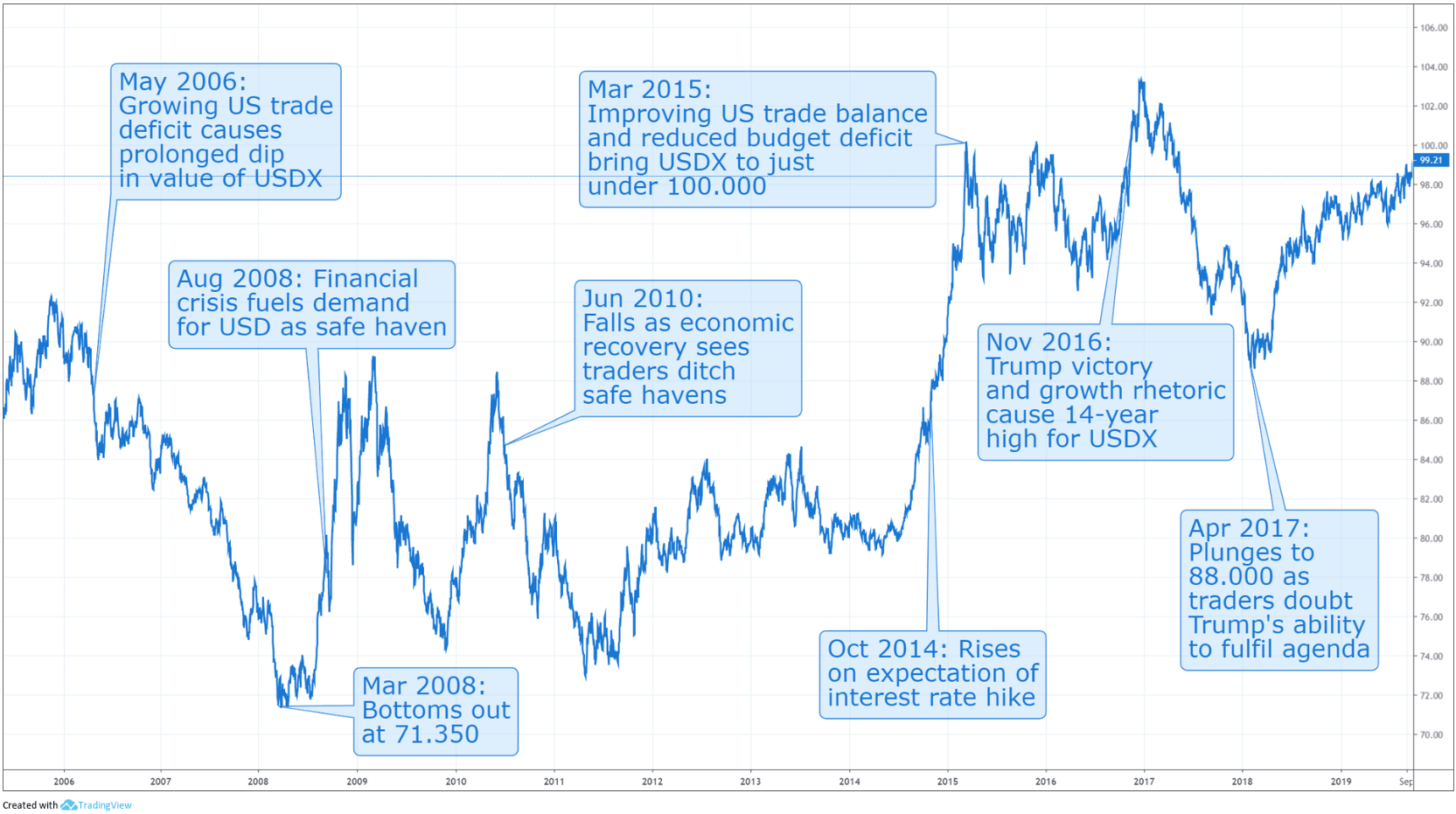

The US dollar performance has been under significant scrutiny in 2023, as analysts predict it may record its worst annual results since 2017. According to a report from Lee Hardman at Mitsubishi UFJ, the US dollar index is projected to drop by 9.3% this year, showcasing pronounced dollar weakness. This decline echoes similar patterns observed during the initial stages of President Trump’s administration, raising concerns about the sustainability of the dollar’s value. With the Federal Reserve initiating cuts to interest rates while other G10 central banks have halted their easing measures, the yield spread is expected to tighten, further impacting economic forecasts. As the market adapts to these shifts, many are watching closely to see how the dollar’s trajectory unfolds in the coming months.
In examining the value of the US currency, this discussion on dollar dynamics reveals crucial insights for investors and economists alike. The depreciating trend in the greenback, particularly highlighted in the latest Mitsubishi UFJ analysis, indicates challenges such as the rising interest rate adjustments by the Federal Reserve. This landscape of dollar fluctuations, especially marked by significant downturns, showcases how interconnected global financial systems and local economic policies influence currency strength. As analysts parse through these trends, understanding the nuances behind the dollar index and its implications for international trade becomes paramount. Overall, the performance of the world’s primary reserve currency remains a critical focal point for those navigating financial markets in 2023.
The US Dollar Performance in 2023: A Year of Decline
The US dollar is poised to face its most significant decline since 2017, with projections indicating a drop of 9.3% in the US dollar index for the year. This performance can be attributed to the Federal Reserve’s ongoing interest rate cuts, which have diminished the dollar’s appeal to investors seeking higher yields. As major economies gain strength and their respective central banks end their easing cycles, the yield spread that traditionally favored US Treasuries is shrinking. This trend suggests a concerning outlook for the US dollar, as it struggles to maintain its position against other currencies in the global market.
Moreover, historical patterns indicate that the dollar’s downturn in 2023 echoes the economic challenges seen at the beginning of President Trump’s administration. While there was a brief recovery in 2018, characterized by a 4.4% rise in the dollar’s value, current economic forecasts suggest that such a rebound is unlikely this time around. Analysts, including Lee Hardman from Mitsubishi UFJ, express skepticism regarding the dollar’s resilience due to ongoing monetary policy shifts by the Federal Reserve, which continue to influence investor sentiment negatively.
Factors Contributing to Dollar Weakness in 2023
The projected weakness of the dollar in 2023 can be attributed to several critical factors, primarily centered around monetary policy and global economic shifts. The Federal Reserve’s decision to cut interest rates in order to stimulate economic growth is in stark contrast to the approaches taken by other G10 central banks, which have opted to halt easing measures. This divergence in monetary policy creates a scenario where US Treasuries are yielding lower returns compared to international counterparts, deterring investment in dollar-denominated assets and contributing to the overall dollar weakness.
In addition to interest rate considerations, broader economic indicators also point towards a challenging environment for the dollar. Economic forecasts reveal signs of slowing growth in the US, alongside potential fiscal uncertainties that may further impact investor confidence. As the Mitsubishi UFJ report outlines, the combination of narrowing yield spreads and potential economic headwinds presents a precarious backdrop for the US dollar, challenging its valuation as a safe-haven currency.
Comparing the US Dollar Index to Global Currency Trends
As the US dollar index struggles, analyzing its performance against other currencies offers crucial insights into global economic trends. Other major currencies, particularly those of G10 nations, are likely to see strengthened positions as their central banks adopt more favorable monetary policies. The relative strength of these currencies, compared to the dollar, reflects an environment where investors are increasingly seeking stability and higher returns outside of the US. This shift not only reinforces the dollar’s weakness but also highlights the competitive dynamics among global currencies.
Additionally, the dollar’s decline can also be viewed through the lens of shifting economic landscapes and geopolitical factors. Uncertainties surrounding global trade, coupled with rising inflationary pressures, may further dampen the dollar’s standing in international markets. The interplay between various currencies and their underlying economic conditions will continue to shape the trajectory of the US dollar index, painting a complex picture of its competitiveness in the coming months.
Implications of Dollar Weakness for Investors
For investors, the anticipated dollar weakness in 2023 brings both risks and opportunities. Lower returns on dollar-denominated investments may prompt a reallocation of portfolios towards foreign assets, which are perceived to offer more attractive yields. This shift could also influence the commodities market, as a weaker dollar typically leads to higher prices for oil and other goods, impacting strategic investment decisions across various sectors. Understanding these dynamics will be paramount for investors looking to navigate the financial landscape effectively in the face of declining dollar strength.
Moreover, the implications of a weaker dollar on international investments can be profound. Those holding US assets may find their value diminished when converted back to stronger currencies, necessitating a rethink of hedging strategies and risk management. As economic conditions evolve, the insights shared in reports by analysts such as Lee Hardman from Mitsubishi UFJ will be crucial for making informed investment choices that align with the projected currency trends.
The Role of the Federal Reserve in Shaping Dollar Dynamics
The Federal Reserve plays a pivotal role in influencing the trajectory of the US dollar through its monetary policy decisions. By opting to cut interest rates, the Fed signals to the market its approach to stimulating economic activity. However, as seen in recent trends, these rate cuts can also lead to a depreciation of the dollar, particularly when global competitors are not engaging in similar easing. Thus, the Fed’s policies not only affect domestic borrowers and investors but also have broader implications for the dollar’s international standing.
Furthermore, as the Mitsubishi UFJ report suggests, the ongoing adjustments to interest rates will narrow the yield spread between US Treasuries and those of other major economies. This development is significant as it influences investor decisions, potentially leading to capital outflows from the US. As such, the Federal Reserve’s actions necessitate careful monitoring, as they remain a driving force behind the evolving dynamics impacting the US dollar’s performance.
Analyzing Economic Forecasts for the Dollar
Economic forecasts play a crucial role in shaping expectations around the US dollar, particularly as analysts sift through indicators to gauge future trends. The 2023 predictions paint a challenging picture for the dollar, marked by anticipated declines in the US dollar index. These forecasts must consider various factors, including inflation rates, employment data, and overall economic performance. As analysts dissect these elements, the resulting insights can significantly impact investment decisions and strategies aimed at mitigating risks associated with a weakening dollar.
Moreover, leading financial institutions, such as Mitsubishi UFJ, provide valuable perspectives on economic forecasts, adding depth to the analysis. As seen in Hardman’s report, the combination of a declining dollar, shifting interest rates, and the associated economic implications underpins the need for investors and policymakers to stay informed about both domestic and global economic conditions. The reflection of these forecasts on market sentiment can be profound, influencing currency valuations and investor behavior in a rapidly changing economic environment.
Foreign Exchange Markets and the Dollar’s Downtrend
The foreign exchange markets are responding dynamically to the anticipated downtrend of the US dollar, reflecting global economic adjustments and investor realignments. With the dollar under pressure, foreign exchange traders are increasingly looking for opportunities in currencies perceived as stronger or more stable. The concurrent rise of other major currencies, bolstered by more favorable monetary policies, highlights the shifting landscape that the dollar must contend with as it faces headwinds.
In the coming months, it will be critical for market participants to keep a close eye on the dollar’s performance relative to other currencies in the foreign exchange market. The shifts in currency valuations not only affect trade balances but also have broader implications for international relations and economic stability. Understanding the mechanics of how the dollar interacts with other currencies can provide essential insights for traders and analysts alike as they navigate these complex market dynamics.
Market Sentiment and the Future of the Dollar
Market sentiment plays a significant role in the trajectory of the US dollar, influencing how investors react to economic reports and Federal Reserve announcements. As the dollar approaches its worst performance since 2017, negative sentiments may foster a cyclical trend of further selling pressure. Analysts suggest that a consistent decline could lead to heightened volatility, creating a challenging environment for the dollar and prompting investors to consider alternative assets.
Additionally, as market sentiment shifts, the perception of the dollar’s strength or weakness can rapidly change based on new economic data or geopolitical developments. It is crucial for participants in financial markets to remain vigilant about these sentiments, as they directly inform trading decisions and long-term strategies. The evolving relationship between market sentiment and the US dollar will continue to be a must-watch aspect of global finance.
Conclusion: The Path Ahead for the US Dollar
The outlook for the US dollar appears increasingly uncertain as it heads into 2023. With projections from analysts at Mitsubishi UFJ indicating that the dollar index will decline significantly, investors must prepare for a potentially extended period of dollar weakness. The interplay of monetary policy, global economic conditions, and market sentiment will be key determinants in shaping the future performance of the dollar.
Moving forward, stakeholders must closely monitor developments surrounding Federal Reserve interest rate decisions and their implications for the dollar. As economic forecasts suggest challenging times ahead, understanding the interconnected factors influencing the dollar will be essential for navigating the financial landscape. Overall, preparing for possible fluctuations and adjustments will be paramount for investors contemplating their positions in the face of ongoing challenges for the US dollar.
Frequently Asked Questions
What is the current US dollar performance trend in 2023?
The US dollar is anticipated to register its worst performance in several years in 2023, with projections indicating a decline of approximately 9.3% in the US dollar index. This downturn is largely influenced by interest rate cuts from the Federal Reserve, contrasting with other G10 central banks that have halted their easing measures.
How is dollar weakness in 2023 related to Federal Reserve interest rates?
Dollar weakness in 2023 is significantly linked to the Federal Reserve’s decision to cut interest rates. As the Fed reduces rates, the yield on US Treasuries becomes less attractive compared to other global bonds, narrowing the yield spread and contributing to a decline in the US dollar’s value.
What factors are contributing to the predicted decline in the US dollar index?
Several factors are contributing to the predicted decline in the US dollar index, including the Federal Reserve’s interest rate cuts and global economic conditions. Analysts, including Lee Hardman from Mitsubishi UFJ, suggest that as the Fed eases policies while other central banks stabilize, the dollar’s performance is likely to weaken.
Is a recovery in US dollar performance expected after 2023?
Experts believe that a significant recovery in US dollar performance, similar to the 4.4% rise seen in 2018, seems unlikely for 2024. The ongoing cuts to interest rates by the Federal Reserve may continue to exert downward pressure on the dollar’s value.
What do economic forecasts say about the US dollar’s outlook for 2024?
Economic forecasts, including insights from the Mitsubishi UFJ report, indicate that the outlook for the US dollar in 2024 remains uncertain, with expectations of continued weakness as the Federal Reserve’s rate cuts play a crucial role in the dollar’s performance relative to other currencies.
| Key Points |
|---|
| Lee Hardman, analyst at Mitsubishi UFJ, forecasts a decline in the US dollar. |
| The dollar is expected to register its worst annual performance since 2017. |
| The US dollar index is predicted to decline by 9.3% this year. |
| The downturn in the dollar coincides with early President Trump era from 2017. |
| The dollar rose by 4.4% in 2018, but a similar recovery is unlikely next year. |
| Federal Reserve interest rate cuts are contributing to dollar weaknesses. |
| Yield spread between US Treasuries and other major economies is narrowing. |
Summary
The US dollar performance is trending towards its worst year since 2017, as predicted by analyst Lee Hardman. This year, the US dollar index is expected to decline by 9.3%, marking significant weakness amidst ongoing interest rate cuts by the Federal Reserve. While the dollar managed to recover slightly in 2018, it is unlikely to see a similar resurgence in the coming year. The narrowing yield spread between US Treasuries and those of other G10 economies further indicates ongoing challenges for the dollar’s value.
Related: More from Market Analysis | Earnings season is wrapping up with a mixed bag of results across | Polymarket Bet Fails to Catch Insider Traders

