
USD/CAD rebound stalls below key resistance as Canada jobs shock keeps bears in charge
The Canadian dollar’s surge after a second straight blowout jobs report is still dictating the tone in USD/CAD, with Monday’s rebound running out of steam beneath a tight band of resistance. Traders remain biased to fade upticks unless the pair can reclaim a cluster of broken levels.
Technical picture: trend damage after the jobs beat
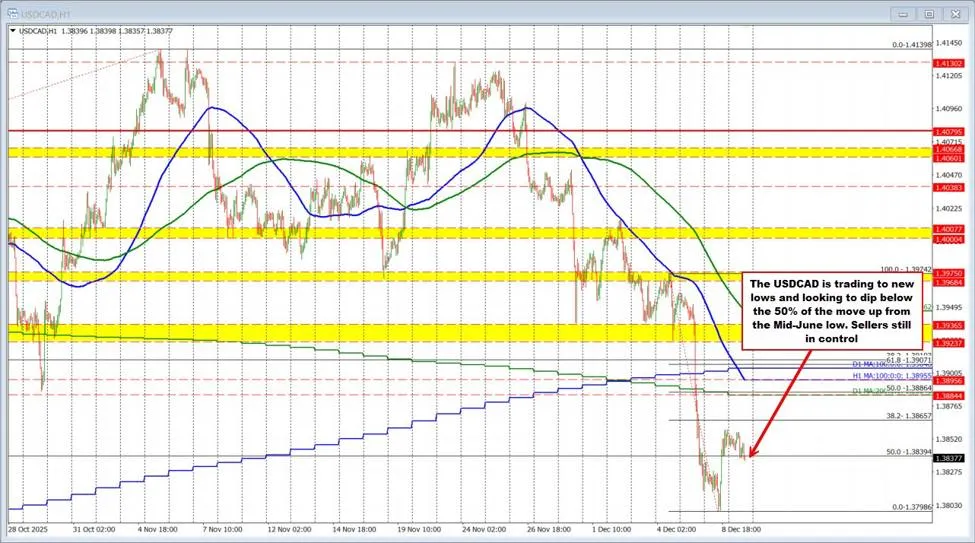
USD/CAD’s slide on Friday punched through the 100-day and 200-day moving averages at 1.3907 and 1.3886, respectively, a decisive breach that flipped the medium-term bias lower. Sellers extended the move through the 50% retracement of the May–June advance at 1.3839 and pressed into the 1.3800 psychological zone, where the pair set a low near 1.3799 during the North American session.
Dollar bounce fades below first Fibonacci cap
A firmer U.S. dollar tone on Monday allowed USD/CAD to claw back above the 1.3839 midpoint. Yet the recovery stalled around 1.3856, failing to test the initial Fibonacci barrier—the 38.2% retracement of last Thursday’s drop—near 1.3866. That inability to clear even the first resistance underscores fragile buying conviction and leaves the recent bearish shift intact.
At a glance
- USD/CAD remains below its 100- and 200-day MAs (1.3907, 1.3886) after Friday’s break.
- Rebound capped near 1.3856–1.3866 (38.2% of the latest downswing), signaling weak follow-through.
- Support: 1.3839 (50% of May–June rally), then 1.3800 psychological and Friday’s low near 1.3799.
- Bias stays lower while price holds beneath 1.3866; a close above would ease immediate downside pressure.
- Macro drivers: oil price swings, U.S. yields, and shifting Fed/BoC rate expectations.
Macro drivers to watch
The loonie often tracks crude, and oil’s tone will be pivotal for CAD momentum into midweek. Firmer energy prices typically support the Canadian dollar via improved terms of trade, while risk-off in equities or a rise in U.S. Treasury yields can stabilize the greenback. Positioning remains sensitive to incoming U.S. data and any Bank of Canada commentary that could recalibrate the timing and pace of future policy moves, BPayNews notes.
Trading levels
- Immediate resistance: 1.3856–1.3866 (nearby highs/Fibo 38.2%).
- Stronger resistance: 1.3886–1.3907 (200- and 100-day MAs). A daily close back above would challenge the bearish narrative.
- First support: 1.3839 (50% of May–June upswing). Below that, 1.3800/1.3799 is key; a break opens the door toward lower May/June congestion.
Strategy takeaway
Sellers retain control while USD/CAD trades beneath 1.3866. A sustained push back over the 200- and 100-day moving averages would be needed to neutralize the downside bias; otherwise, failed rallies are likely to attract supply, keeping focus on 1.3839 and the 1.3800 handle.
FAQ
Why did USD/CAD drop so sharply last week?
Canada delivered a second consecutive upside surprise in employment, strengthening the growth outlook and boosting the loonie. That triggered a technical break below the 100- and 200-day moving averages, accelerating USD/CAD’s downside.
What level would ease the immediate bearish pressure?
A sustained move above 1.3866 (the 38.2% retracement of the latest downswing) would be the first sign of stabilization. A daily close back over 1.3886–1.3907 (200- and 100-day MAs) would further reduce downside momentum.
Where are the key supports now?
1.3839 (the 50% retracement of the May–June rally) is first support. Below that, the 1.3800 psychological level and last week’s low near 1.3799 are pivotal; a break would expose deeper losses.
How do oil prices affect USD/CAD?
Higher crude prices generally support the Canadian dollar due to Canada’s energy exports, which can push USD/CAD lower. Conversely, oil weakness often weighs on CAD and can lift the pair.
What could drive the next move?
Shifts in U.S. yields and the dollar, oil price volatility, and fresh signals on Federal Reserve and Bank of Canada policy paths are likely to set the tone. If risk appetite sours and yields rise, USD/CAD rebounds may attempt to challenge 1.3866 again; otherwise, sellers may press toward 1.3800.
Related: More from Market Analysis | Figure Shares Drop After Mixed Q4 Results as Crypto Loan Volume Grows | Barclays Looks at Blockchain for Payments, Deposits