
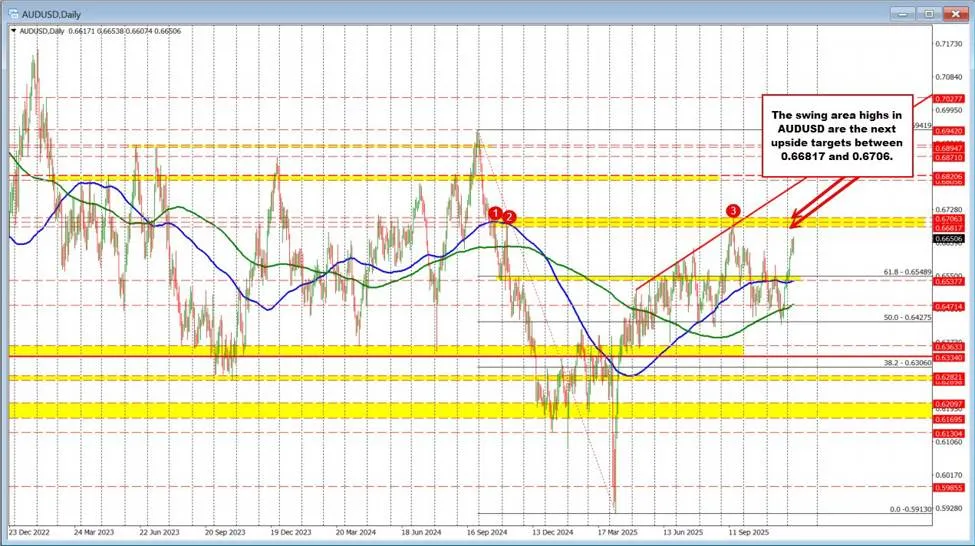

AUD/USD surges to multi‑month high as RBA holds rates but hints at tightening; bulls target 0.6700 zone
The Australian dollar ripped higher after the Reserve Bank of Australia kept policy steady but leaned hawkish, pushing AUD/USD through a key resistance cluster. Traders are now eyeing 0.6682–0.6706 into the RBA’s February meeting, with the 100-hour moving average acting as the line in the sand for momentum, BPayNews reports.
RBA turns the screw without hiking
The RBA left the cash rate unchanged, but Governor Michele Bullock’s guidance signaled the central bank remains prepared to tighten further if inflation proves sticky. With no meeting in January, the next policy decision comes in February—after fresh monthly CPI readings and the crucial Q4 inflation report. OIS pricing shifted to reflect a higher probability of a move early in 2025, lifting front‑end yields and extending support for the Aussie.
Aussie breaks out as buyers overwhelm resistance
AUD/USD burst above a thicket of recent swing highs near 0.6648, a level that capped rallies on Friday, Monday, and earlier today. The clean topside break points to improving risk appetite toward the currency and likely triggered stops, fueling momentum. The move keeps the pair on track to test a well-flagged resistance band between 0.66817 and 0.6706—the latter marking the 2024 high set in September.
What traders need to know
- Policy signal: RBA held rates but struck a hawkish tone, keeping a potential February hike on the table if inflation doesn’t cool.
- Breakout confirmed: AUD/USD cleared 0.6648, shifting near-term control to buyers and opening scope toward 0.6682–0.6706.
- Key support: The 100-hour MA at 0.66235 is the pivot; sustained trade above it keeps dip‑buyers in charge.
- Yearly marker: A push through 0.6706 would challenge the 2024 high and strengthen the medium‑term bullish narrative.
- Event risk: Australian monthly CPI and Q4 inflation (due late January) will shape February RBA odds and FX volatility.
Technical roadmap: momentum favors the upside
– Immediate resistance: 0.66817–0.6706 (multi‑month highs; 2024 peak at 0.6706). A daily close above the zone would validate a bullish breakout and expose higher levels into the low‑0.67s.
– First support: prior breakout area around 0.6648/0.6649. A retest that holds would reinforce the trend.
– Trend pivot: 100‑hour MA at 0.66235. A decisive move back below would dent momentum and shift focus toward the psychological 0.6600 handle.
Macro lens: inflation path and liquidity conditions
The RBA’s “wait‑but‑ready” stance keeps Australian front‑end yields underpinned and lends support to the currency, particularly with year‑end liquidity thinning and FX ranges prone to outsized moves. The policy debate hinges on incoming inflation data: persistent services inflation or firm labor metrics would justify the central bank’s hawkish bias, while a softer price pulse could unwind part of the Aussie’s premium. Commodity trends—especially iron ore and China‑related risk—remain secondary but important pillars for AUD performance.
FAQ
Why did AUD/USD rally after the RBA decision?
Because the RBA held rates but guided hawkishly, keeping the door open to further tightening if inflation stays high. That shift buoyed Australian yields and helped AUD/USD break key resistance, amplifying gains via stop‑loss buying.
What levels matter now for AUD/USD?
Upside focus is 0.66817–0.6706 (with 0.6706 the 2024 high). On the downside, watch 0.6648 (breakout retest) and the 100‑hour MA at 0.66235. Losing the moving average would weaken bullish momentum.
When is the next RBA meeting?
February, after the central bank’s summer break. Markets will parse the monthly CPI indicators and the Q4 CPI release in late January ahead of that meeting.
What could reverse the Aussie’s gains?
A downside surprise in Australian inflation, a sharp deterioration in domestic growth or labor data, or a strong U.S. dollar rebound could pressure AUD/USD. Technically, a sustained break below 0.66235 would hand the near‑term edge back to sellers.
How do upcoming CPI prints impact RBA odds?
Stronger‑than‑expected inflation, especially in services, would keep February hike bets alive and support AUD. Softer readings would reduce tightening risk and likely cap the currency.
Do commodities matter for the Aussie here?
Yes. Australia’s terms of trade are highly sensitive to commodities like iron ore. Firm prices and improving China sentiment tend to bolster AUD, while commodity weakness can blunt policy‑driven rallies.
Related: More from Market Analysis | Figure Shares Drop After Mixed Q4 Results as Crypto Loan Volume Grows | Barclays Looks at Blockchain for Payments, Deposits