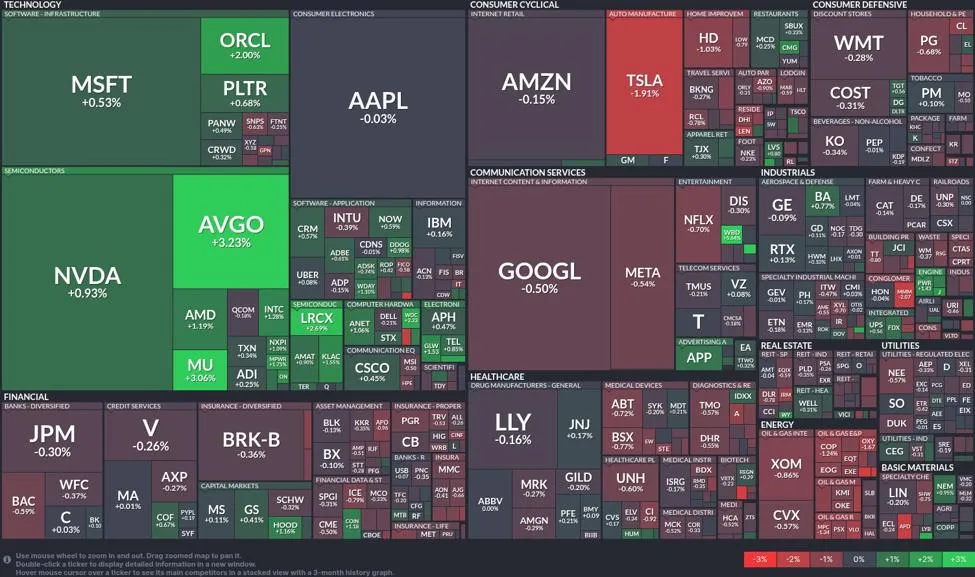

Oracle, Broadcom ignite tech rally; chip surge steadies Wall Street as Tesla, ad giants slip US stocks leaned higher Monday as a tech-led advance offset pockets of weakness in autos and communication services. Gains in semiconductors and enterprise software—powered by Broadcom and Oracle—kept risk appetite intact, even as Tesla and ad-heavy mega caps eased.
Tech-led advance puts semiconductors back in the driver’s seat
Broadcom (AVGO) rallied about 3.2%, extending strength across the semiconductor complex amid ongoing enthusiasm for AI infrastructure and data-center buildouts. Oracle (ORCL) climbed roughly 2.0%, buoying software infrastructure peers as investors bet on steady enterprise demand and cloud workloads. Chipmakers were broadly firmer: Nvidia (NVDA) rose around 0.9%, Advanced Micro Devices (AMD) added about 1.2%, and Micron Technology (MU) gained roughly 3.1%. The bid in semis reflects expectations for a durable AI cycle, healthier memory pricing, and resilient hyperscaler capex—key pillars underpinning tech’s outperformance and keeping the Nasdaq’s leadership in place.
Cyclicals mixed; communication services eases
The broader market tone was constructive but not uniform. Amazon (AMZN) edged lower (~0.2%), while Tesla (TSLA) fell nearly 1.9%, signaling continued scrutiny of auto demand, pricing, and margin trajectory. Communication services lagged as Alphabet (GOOGL) and Meta Platforms (META) slipped about 0.5%, with investors weighing the outlook for digital advertising and regulatory risks.
Cross-asset lens: why FX and rates still matter
The tech bid typically aligns with modestly stronger risk appetite, a backdrop that can favor pro‑cyclical currencies if sustained. However, the path for FX will hinge on rate expectations and bond market stability. Equity leadership concentrated in semis often coincides with contained volatility and a steady Treasury backdrop; any abrupt move in yields could swiftly alter the dollar’s tone and broader risk sentiment. Traders remain sensitive to incoming macro signals that could recalibrate growth and inflation narratives.
Market snapshot
- Tech outperforms: Oracle (ORCL) ~+2.0%; Broadcom (AVGO) ~+3.2% lead gains.
- Semis firm: Nvidia (NVDA) ~+0.9%; AMD ~+1.2%; Micron (MU) ~+3.1% on AI and memory tailwinds.
- Cyclical divergence: Amazon (AMZN) ~-0.2%; Tesla (TSLA) ~-1.9% under pressure.
- Ad-heavy mega caps softer: Alphabet (GOOGL) ~-0.5%; Meta (META) ~-0.5%.
- Risk tone: Constructive but selective; leadership remains concentrated in AI-linked winners.
What traders are watching next
– Guidance and order visibility across the chip supply chain remain central to the AI thesis. Any signs of inventory normalization or capex delays could challenge momentum. – For software, durable cloud demand and upsell into data/AI services are key performance drivers. – Cross-asset confirmation—steady yields and contained FX volatility—would help sustain the multiple expansion underpinning tech.
FAQ
Why are semiconductor and software stocks leading?
AI infrastructure spending, improving memory pricing dynamics, and firm cloud demand are supporting chips and enterprise software. Investors continue to reward companies with clear exposure to data-center growth, AI accelerators, and related services.
How does this tech rally affect FX markets?
A risk-on equity tone can be supportive for pro‑cyclical currencies versus defensive havens, but the ultimate FX impact depends on rates. If Treasury yields stay orderly, appetite for carry and cyclicals tends to hold; sharp moves in yields can quickly shift dollar dynamics.
What are the risks to the chip-led advance?
Potential risks include capex delays from hyperscalers, supply bottlenecks, a slower AI monetization path, or a re-acceleration in inflation that pushes yields higher and compresses equity valuations.
Why are communication services stocks softer today?
Alphabet and Meta eased as investors reassessed digital ad spending visibility and regulatory overhangs. In sessions where investors crowd into AI-linked growth, some profit-taking in other megacaps is common.
What does Tesla’s decline signal for cyclicals?
Tesla’s drop underscores sensitivity to EV demand, pricing power, and margin trends. For cyclicals, investors remain selective—favoring companies with strong cash flow visibility and pricing resilience over more rate- and demand-sensitive names.
What’s the near-term set-up for traders?
Focus on earnings updates and guidance from chip and cloud-exposed names, monitor rates and FX for confirmation of risk appetite, and be mindful of narrow leadership. A balanced approach can help navigate selective breadth and headline-driven swings, BPayNews notes.
Related: More from Market Analysis | Earnings season is wrapping up with a mixed bag of results across | Polymarket Bet Fails to Catch Insider Traders