
Dollar Rebounds as Treasury Yields Climb; Stocks Slip, EUR/USD Pressured The US dollar logged its first gain in a week as Treasury yields pushed higher across the curve, pressuring risk assets and knocking EUR/USD toward session lows. Equities softened, with the S&P 500 near its trough, down 18 points to 6832, as traders weighed policy rhetoric from Washington against mixed macro signals and firm odds of a December Fed cut.
Rates surge lifts USD, dents risk appetite
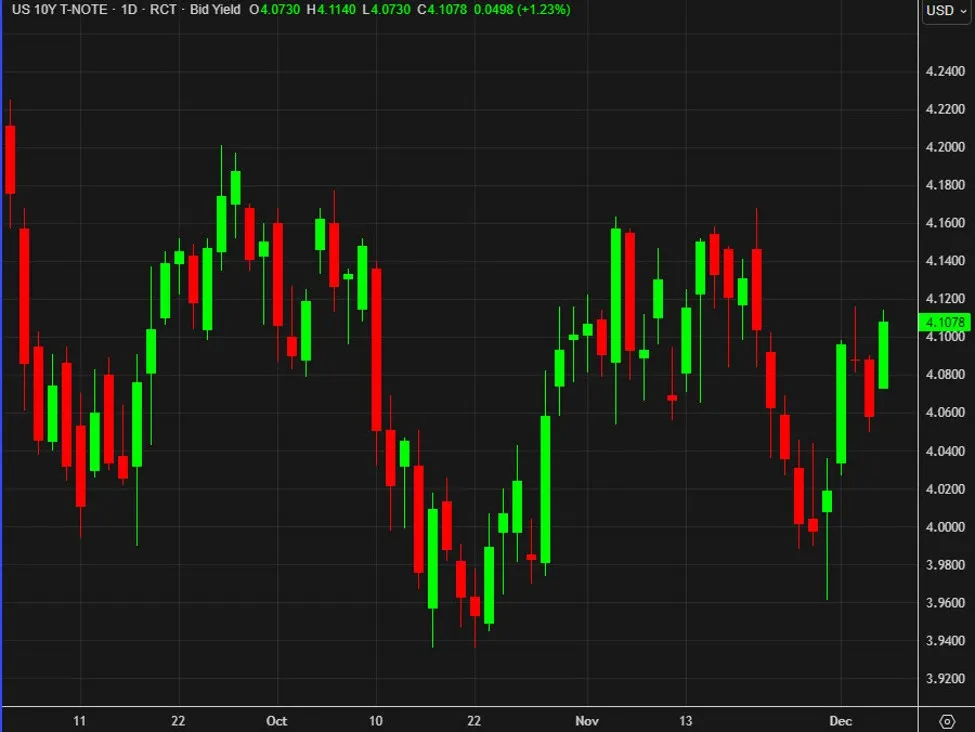
A jump in Treasury yields dominated Thursday’s trade, rekindling dollar demand and tightening financial conditions. The move reflected a blend of policy uncertainty—particularly around deficit reduction plans—and repricing of the Federal Reserve path, with the front end also tilting higher. The 2-year yield rose to 3.53%, edging closer to the current 3.75–4.00% Fed funds target range and signaling markets are reassessing how quickly policy may ease.
Market snapshot
- Treasury yields rise across the curve; front-end rates firm at 3.53% on the 2-year.
- US dollar posts first weekly gain; EUR/USD down about 20 pips and near session lows.
- S&P 500 slips 18 points to 6832 as higher yields weigh on equities.
- Futures imply roughly 85% odds of a Fed rate cut on Dec. 10, even as inflation worries persist further out the curve.
- Washington deficit messaging remains mixed, fueling uncertainty around fiscal trajectory.
Policy fog from Washington complicates rates outlook
Conflicting signals on deficit priorities added to market noise. Former President Trump has alternated between using tariffs to pay down a deficit running above 6% of GDP and redirecting potential tariff revenues toward farmers, factories, or direct cash payments. The ambiguity keeps term premia sensitive, with long-dated yields vulnerable to shifts in perceived fiscal discipline and inflation risk.
Fed cut odds stay high despite uneven data
Markets remain about 85% priced for a rate cut at the December 10 meeting. Paradoxically, the prospect of near-term easing may be stoking longer-run inflation concerns, nudging yields up across maturities. Recent US jobs indicators have softened, but retail sales have held up outside a few weak pockets—leaving growth signals muddy and amplifying the market’s data dependency. Thin catalysts today kept price action dominated by rates and dollar positioning, with FX volatility picking up as the dollar strengthened.
FX focus: EUR/USD on the back foot
Dollar strength weighed on the euro, pushing EUR/USD lower by roughly 20 pips. The pair’s intraday slide mirrors broader risk aversion and higher US rates, with traders watching whether front-end yield resilience continues to underwrite USD support. A sustained break lower would likely require either a further bear move in US rates or fresh eurozone-specific weakness; absent that, liquidity gaps could drive choppy reversals.
What’s next for traders
With a sparse US data calendar, attention falls on upcoming labor and inflation prints, Treasury auctions, and remarks from Fed officials for guidance on the policy path into year-end. Equity volatility tends to rise when front-end yields challenge the policy rate, and FX traders will watch whether the dollar’s bounce extends if yields continue to firm. This report was prepared for BPayNews readers.
FAQ
Why is the US dollar rising today?
Higher Treasury yields boosted the dollar’s carry and safe-haven appeal. As front-end rates climbed and term premia widened, USD demand improved, lifting the currency to its first gain in a week.
How are higher yields affecting stocks?
Rising yields tighten financial conditions and pressure equity valuations, particularly for longer-duration growth names. That dynamic contributed to the S&P 500’s decline, with the index near session lows.
What are markets pricing for the next Fed meeting?
Futures indicate about an 85% probability of a rate cut on Dec. 10. However, the move up in both short and longer-dated yields suggests investors are hedging against stickier inflation or stronger growth later on.
Why does Washington’s deficit debate matter for yields?
Uncertainty over how the US will address a deficit exceeding 6% of GDP affects expectations for Treasury supply, inflation, and term premia. Mixed signals—such as funding cuts via tariffs versus new spending—can push longer-dated yields higher.
What’s moving EUR/USD?
EUR/USD is lower as the stronger dollar and higher US yields weigh on risk sentiment. In the absence of strong euro-area catalysts, the pair is tracking US rate dynamics and broad USD performance.
What should traders watch next?
Labor-market updates, CPI/PCE inflation data, Treasury auctions, and Fed communications. These will shape the policy path and determine whether the dollar’s recovery and the yield backup persist.
Related: More from DeFi & Stablecoins | Stablecoin Payments Focus Shifts to User Networks | Germany Launches Regulated Stablecoin Pegged to Swiss Franc