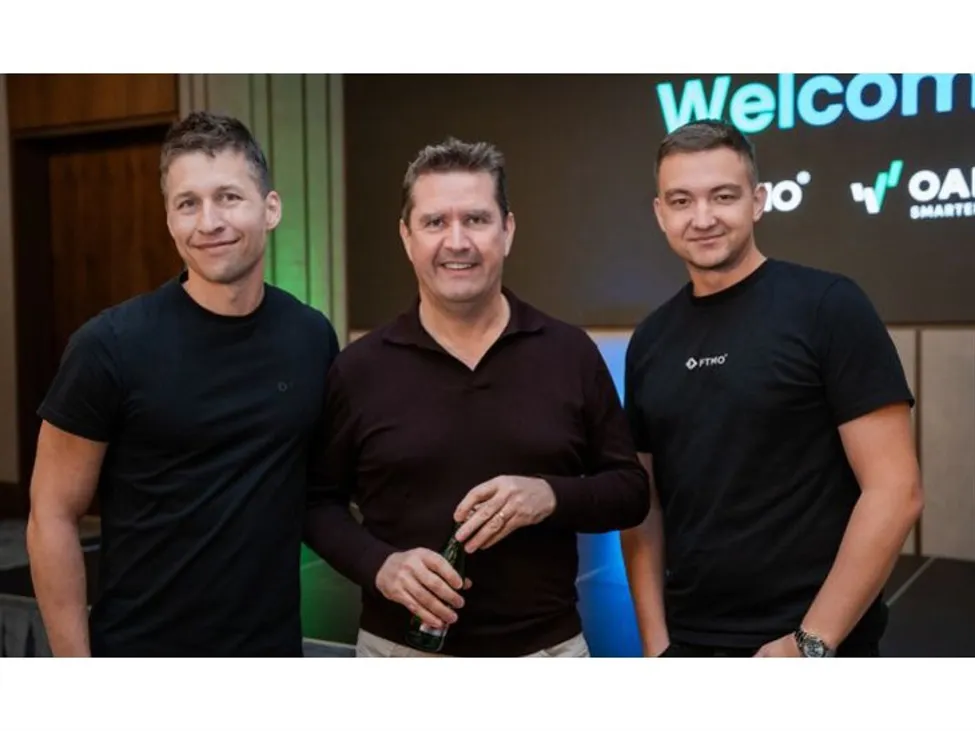

FTMO completes OANDA takeover, fusing prop trading scale with a global FX brokerage footprint FTMO has closed its acquisition of OANDA Global Corporation after securing five regulatory approvals, uniting one of the most prominent prop trading platforms with a multi-asset, highly regulated retail FX broker. The move could reshape the retail trading value chain—from education and funded trading to execution, data and analytics—at a time of intensifying competition and oversight in global FX.
Why this deal matters for FX markets
The tie-up pairs FTMO’s large pipeline of active, evaluation-stage traders with OANDA’s licensed brokerage infrastructure across eight major jurisdictions, including the U.S., U.K., Canada, Singapore, Japan, Australia and others. For market participants, the integration potential spans client acquisition, risk management, data services and execution quality, with possible knock-on effects for pricing, liquidity access and product breadth.
Key Points
- FTMO has finalized the purchase of OANDA from CVC Asia Fund IV after an approximately eight-month approval process.
- Regulatory clearances were obtained from five authorities; the deal closed on December 1, following the final approval in November.
- OANDA will operate as a standalone business under FTMO’s ownership; financial terms remain undisclosed.
- The combination links a leading prop trading ecosystem with a regulated, multi-asset broker known for FX, indices, commodities and data services.
- Advisers: FTMO retained J.P. Morgan (financial) and Latham & Watkins LLP (legal); CVC was advised by Milbank LLP (legal) and joint financial advisers Nomura and Santander.
Strategic implications for traders and brokers
FTMO’s core model—education, evaluation and capital allocation—has cultivated significant trader throughput and data. OANDA brings regulated execution, risk controls and multi-asset access built over nearly three decades. Together, the group can streamline the trader journey from training through to live markets, while potentially enhancing product access, analytical tools and risk management overlays. For FX markets, deeper alignment between prop firms and brokers could: – Concentrate retail flow through licensed venues, augmenting transparency and supervision. – Support tighter spreads and improved fills if scale boosts liquidity relationships. – Accelerate product innovation in areas like analytics, risk dashboards and API connectivity.
Regulatory and market context
The completion follows a year of heightened regulatory attention on retail leverage, disclosures and prop firm practices across multiple jurisdictions. Consolidation among platforms and brokers has been a theme as firms seek diversified revenues, stronger compliance programs and broader global footprints. With entities and leadership across hubs such as New York, London, Toronto, Singapore, Tokyo, Sydney and Warsaw, OANDA adds depth and credibility to FTMO’s expansion roadmap.
What changes now—and what doesn’t
FTMO plans to keep OANDA as a standalone business, signaling continuity for existing brokerage clients. Near-term operational changes are unlikely, with integration expected to focus on selective synergies—technology sharing, data products, cross-distribution and client-centric features—while preserving regulatory firewalls and jurisdiction-specific obligations.
Deal timeline and counterparties
FTMO signed a purchase agreement with CVC earlier this year, contingent on customary approvals. After securing the final clearance in November, the transaction closed on December 1. CVC had owned OANDA since 2018, part of its broader private equity strategy in financial services.
Industry outlook
FX volatility has moderated from 2022 highs but remains sensitive to rate differentials, U.S. growth resilience, and policy signals from the Fed, ECB and BOJ. In that environment, execution quality, cost of carry and platform reliability carry greater weight for active traders. The FTMO–OANDA combination positions the group to compete on those dimensions, while tapping a global pipeline of both prop and retail flows.
About the companies
– FTMO: A technology-driven prop trading and education provider operating in more than 140 countries, known for evaluation programs and risk management frameworks. – OANDA: Founded in 1996, offers multi-asset trading, FX data and analytics to retail and corporate clients, with regulatory coverage across eight key markets.
Advisers
– FTMO: J.P. Morgan (financial advisor), Latham & Watkins LLP (legal) – CVC: Nomura and Santander (joint financial advisors), Milbank LLP (legal)
FAQ
Who acquired OANDA and when did the deal close?
FTMO acquired OANDA from CVC Asia Fund IV. The deal closed on December 1 after FTMO secured five regulatory approvals, with the final clearance arriving in November.
What does OANDA bring to the table?
OANDA is a long-standing, regulated multi-asset broker offering FX, indices, commodities and analytics, with entities across major financial hubs. Its risk controls and licensing complement FTMO’s prop trading and education ecosystem.
Will OANDA clients see immediate changes?
No immediate changes are expected. FTMO plans to keep OANDA as a standalone business, maintaining current operations while exploring technology and product synergies over time.
Why does this matter for forex and CFD traders?
The pairing could enhance execution quality, data tools and product breadth. Scale benefits may eventually influence spreads, liquidity access and platform features, while remaining under rigorous regulatory oversight.
Is the purchase price disclosed?
No. The parties have not disclosed the transaction value.
How is OANDA regulated?
OANDA holds licenses across eight major jurisdictions, including entities in the U.S., U.K., Canada, Singapore, Japan, Australia and other markets, subject to local rules and protections.
What does it mean for prop traders using FTMO?
Over time, traders could see deeper integration of analytics, risk tools and potential access pathways into regulated execution venues, though FTMO has not announced specific product changes.
Who advised the parties?
FTMO worked with J.P. Morgan and Latham & Watkins LLP. CVC received legal counsel from Milbank LLP and financial advice from Nomura and Santander.
What’s the broader industry takeaway?
Consolidation is knitting together education, prop capital and regulated execution. For the FX market, that can mean stronger compliance, better tooling and potentially improved pricing—key themes to watch, BPayNews notes, as liquidity and volatility dynamics evolve into next year.
Related: More from Regulation & Policy | Anthropic Founder Critiques Pentagons Choice as Unprecedented in Crypto Regulation | UK Gambling Regulator Examines Cryptocurrencies for Licensed Bettors in Crypto Regulation