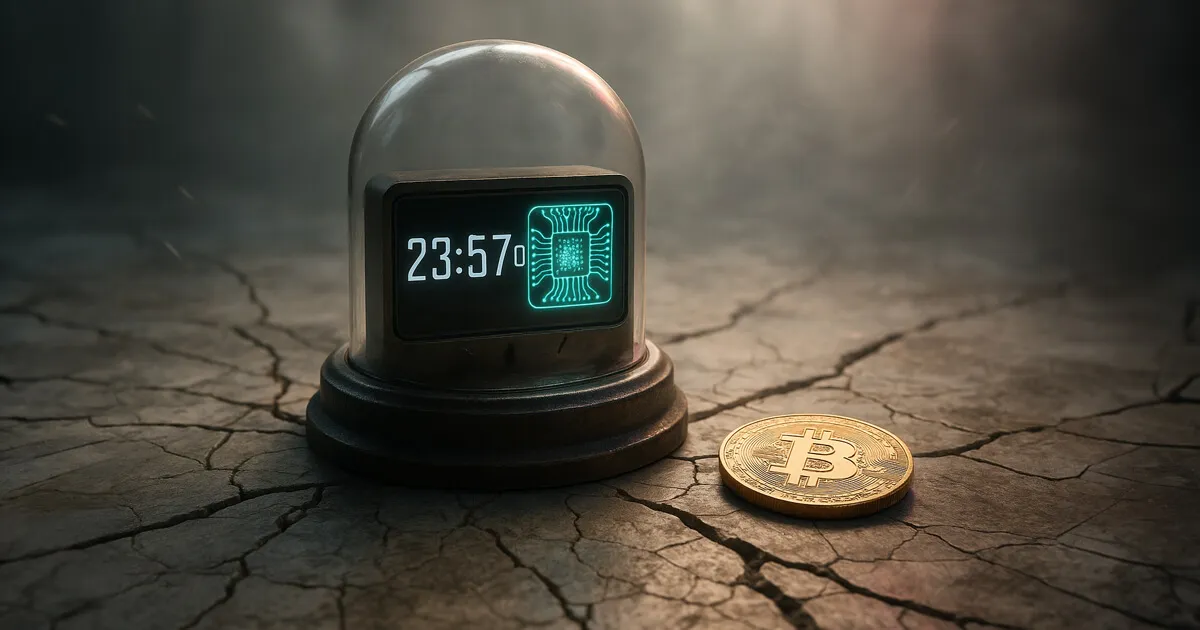

Bitcoin May Break by 2028 Without Quantum Resistance
As we look towards the future of cryptocurrencies, one looming threat that could potentially disrupt the entire blockchain ecosystem is quantum computing. Bitcoin, the first and most widely used cryptocurrency, is at particular risk. Analysts, experts in cryptography, and quantum scientists are increasingly pointing out that without significant updates to its underlying technology, Bitcoin might be vulnerable to quantum attacks by 2028.
Key Takeaways
The Quantum Threat to Bitcoin
At the heart of Bitcoin’s security is the cryptographic technique known as the SHA-256 algorithm, paired with elliptic curve digital signature algorithm (ECDSA) for wallet security. These cryptographic systems are considered secure against conventional computing threats and have successfully protected Bitcoin from various types of cyberattacks since its inception. However, they are not invulnerable to quantum computing—a new type of computing that uses quantum-mechanical phenomena, such as superposition and entanglement, to perform operations on data.
Quantum computers, though still in the early stages of development, promise to be enormously powerful. They have the potential to perform complex calculations at speeds unattainable by today’s classical computers. One algorithm, in particular, poses a significant threat to Bitcoin: Shor’s Algorithm, which is capable of factoring large integers and solving discrete logarithm problems, the backbone of most classical cryptographic systems, in polynomial time. This capability could theoretically allow a quantum computer to derive private keys from public ones, effectively breaking Bitcoin’s security.
Estimations of a Quantum Timeline
Recent advancements in quantum technology have led analysts to predict that quantum computers might reach the capability to break Bitcoin’s cryptographic defenses by 2028. Companies like Google, IBM, and various governmental and military agencies are making strides in quantum research, pushing forward the timeline when a sufficiently powerful quantum computer could exist.
The Current State of Bitcoin
As of now, Bitcoin does not have inherent quantum resistance. This vulnerability is due to the widespread use of public-key cryptography for generating Bitcoin addresses. Once a Bitcoin address is used, its public key is revealed on the blockchain, making it susceptible to a potential quantum attack.
The Path to Quantum Resistance
The good news is that the crypto community is aware of these potential quantum threats, and researchers are actively working on quantum-resistant blockchain technologies. Several post-quantum cryptographic methods, which involve algorithms that are secure against quantum computing attacks, are under development. These methods need to be both secure and efficient enough to be implemented on a scale as large as Bitcoin’s network.
Upgrading Bitcoin to use these new cryptographic systems is not a trivial task. It requires a consensus within the community and a coordinated global effort among all stakeholders. Such an upgrade would likely result in a hard fork, as it could not be implemented as a simple software update. Historical precedents, like the SegWit update, have shown that major changes in Bitcoin’s protocol can be contentious and difficult to achieve.
Conclusion
The progress of quantum computing is a double-edged sword. While it holds vast potential for scientific advancement, it also poses severe risks to systems like Bitcoin that rely on traditional cryptographic measures. It is imperative for the Bitcoin community, and the broader crypto ecosystem, to prioritize the development of quantum-resistant technologies. Preparing now for the advent of quantum computing is not just prudent; it is essential for the survival of cryptocurrencies in their current form. Failure to act timely could lead Bitcoin to face an existential threat by as soon as 2028.
Related: More from Bitcoin News | Trump Family backs ABTC: Expands Mining Fleet 12% in Bitcoin | BTC Surges to $68K Amidst Market Downturn in Bitcoin