

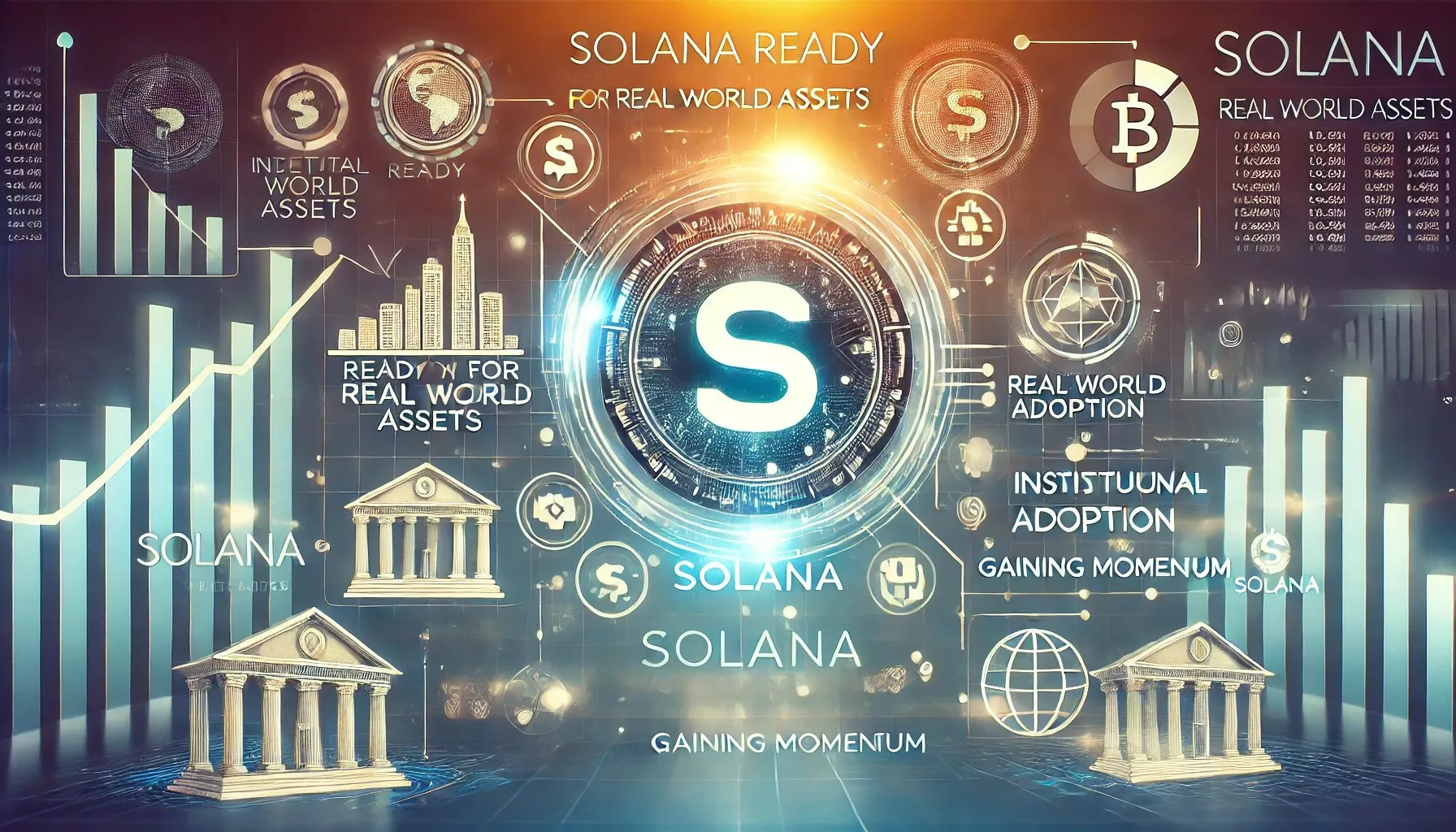

Is Solana Ready for Institutions? Exploring the $700M Real World Assets and Its Impressive Uptime
As cryptocurrencies and blockchain technology continue to revolutionize the financial landscape, institutions are increasingly looking for robust platforms that can handle significant investments and operate with high reliability. Solana, one of the newer entrants in the blockchain space, has rapidly gained attention with its promise of high throughput and low transaction costs. Recently, Solana has demonstrated its capacity for institutional-level operations, managing approximately $700 million in real-world assets without experiencing downtime. This development raises the question: Is Solana truly ready for institutional adoption?
Solana's Infrastructure and Technological Edge
To evaluate Solana’s readiness for institutional involvement, one must consider its underlying technology and infrastructure. Known for its incredible speed and efficiency, Solana uses a unique hybrid consensus model combining proof-of-history (PoH) with proof-of-stake (PoS). This innovative approach allows the blockchain to process thousands of transactions per second, significantly higher than older blockchains like Bitcoin and Ethereum.
Moreover, Solana’s architecture is designed to scale with hardware improvements, making it one of the few blockchains that could manage increased throughput without substantial changes to its protocol. This aspect is crucial for institutions that require a scalable and future-proof platform.
Handling $700 Million in Real Assets
The fact that Solana has successfully handled $700 million in real-world assets is a significant indicator of its institutional capabilities. These assets, ranging from securitized products to financial instruments, require a blockchain platform that ensures not only speed but also accuracy, security, and compliance with regulatory standards.
Managing such a large portfolio shows that Solana can handle complex transactions and asset management, providing transparency and efficiency. For institutions, the ability to oversee such operations without encountering issues such as network downtime or security breaches is paramount.
Network Stability and Reliability
One of the critical factors for any technology aiming to attract institutional investors is reliability. In the past, Solana has faced criticism over network stability issues, with several high-profile outages reported. However, in the recent phase, Solana has shown improvements in network stability and has maintained operations without significant downtime.
This reliability is crucial not just for the sake of uninterrupted services but also for maintaining trust and security. Institutions require a blockchain not only to be fast but also available and robust at all times. The recent track record of no downtime while managing substantial assets is a testament to the maturing of the Solana network’s infrastructure.
Institutional Confidence and Future Considerations
As Solana continues to prove its capability in handling large-scale operations, institutional confidence in the platform may increase. Institutions look for not only performance but also a vibrant ecosystem, developer community, and ongoing support and enhancements to the platform. Solana’s active community and consistent development efforts contribute positively to its institutional appeal.
Moreover, the growing interest in decentralized finance (DeFi) and non-fungible tokens (NFTs) where Solana is positioned well due to its high throughput and low costs, also play a critical role. These factors might encourage more institutions to consider Solana as a viable platform for their blockchain needs.
Conclusion
While early network challenges raised questions about its readiness for widespread institutional use, Solana’s recent performance in managing $700 million in real-world assets with no reported downtime presents a strong case for its institutional readiness. As Solana continues to enhance its network stability and builds on its technological advantages, it stands a good chance of becoming a preferred blockchain platform for institutional investors.
In conclusion, while it is prudent for institutions to proceed with caution given the relative youth of the platform, Solana’s current trajectory indicates a promising future for institutional engagement in the crypto space. The platform’s ability to handle significant asset volumes efficiently and reliably is a clear indicator that it may be ready to take on a bigger role in the institutional financial landscape.
Related: More from Altcoin News | Solana Sale Launches for Bank Stake Pools in Altcoin | Byreal Launches AI Copy Farming Skillset for Solana DEX Agents in Altcoin